Curating Materials to Support STEM Learning with Infants and Toddlers
| June 2026
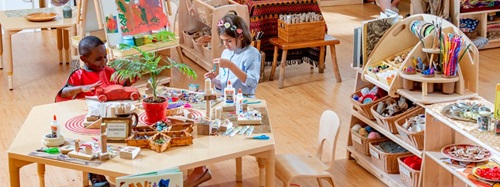
“What kind of work do you do?” I often get a funny look from people when I tell them I develop STEM experiences for infants and toddlers. How can babies do STEM? This is a question I have been defining for the past 10 years. As I have observed both children and adults who support them, I have been inspired by the complexity of young children’s thinking as they are confronted with novel materials and time to explore them. I have observed a non-mobile infant spin a top with her feet (after removing her socks) when it was placed on a vertical mirror; watched an 18-month-old “drive” a large box around the obstacles in his classroom by turning, reversing, lifting, and sliding; listened while an older toddler composed, revised, and played a song for her teacher using cans and a wooden dowel from the sound center; and observed the countless ways that infants and toddlers engineer blocks and building materials in order meet a need that they have identified (a box for hiding objects, a house to go with a barn, a road for driving wooden vehicles, a tower for knocking down). While engaging in these STEM experiences, children can investigate the properties of the materials, discover or create a problem based on their investigation, use old strategies or devise new ones to solve the problem that interests them, combine strategies, observe what works and what does not work, and then try again. All of these actions are foundational to STEM learning.

At the Iowa Regents’ Cener for Early Developmental Education where I am working with others to develop infant and toddler STEM curriculum, our perspective aligns with the definition of STEM the Boston Children’s Museum provides:
- Science is a way of thinking. Science is observing and experimenting, making predictions, sharing discoveries, asking questions, and wondering how things work.
- Technology is a way of doing. Technology is using tools, being inventive, identifying problems, and making things work.
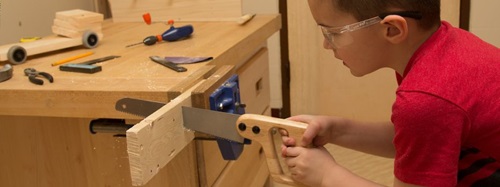
- Engineering is a way of doing. Engineering is solving problems, using a variety of materials, designing and creating, and building things that work.
- Math is a way of measuring. Math is sequencing (1, 2, 3, 4…), patterning (1, 2, 1, 2, 1, 2…), and exploring shapes (triangle, square, circle), volume (holds more or less), and size (bigger, less than). (Brownrigg et al., 2013).
The role of materials is evident in every component of STEM, and an educator’s selection of those materials is crucial in providing high-quality STEM experiences with infants and toddlers. Recent work in pediatric neuroscience further validates the importance of high-quality experiences in shaping the neural architecture of infants’ brains (Zero to Three, 2014). The circuitry of the developing brain is directly affected by the quality of the experiences and the interactions that children are offered (The Center for the Developing Child, 2007). High quality experiences that include sensory, motor, cognitive, and relationship-building opportunities support neural development, while children who are not afforded such brain-building experiences may not develop these neural pathways.
As a constructivist early childhood educator, I have long planned STEM experiences for young children that are grounded in Piaget’s theory of cognitive development which describes the way very young children learn through their senses and motor actions as they construct simple concepts about objects and events and learn about their world. This, along with knowledge of child development acquired over four decades in the field, guides me in the planning process. Materials and experiences are selected based on my observations of children’s interests, their developmental requirements, and developmentally appropriate practices. We urge teachers to begin planning STEM experiences with the question, “What is there in this activity for children to figure out?” (VanMeeteren & Peterson, 2022). The research of Piaget (1967) supports our work with young children as we observe the ways in which they explore materials to “invent their knowledge through manipulation” (Leeb-Lundberg & Hirsch, 2006 p. 40) of those materials. We honor children when we use our observations to provide us with information about children’s growing competence and act on this information by providing novel materials that support their newfound skills and understandings. STEM is not a one-and-done activity but instead is an experience that happens over time.
In my role within the Iowa Regents’ Center for Early Developmental Education, I have the pleasure of working with the teachers at the University of Northern Iowa’s Child Development Center. Together we plan STEM experiences that are implemented in their classrooms over time. The longevity of the experience is dependent on the carefully curated materials that are chosen based on our understanding of the children’s interests and needs. We edit and add materials based on our observations of children and begin a new investigation when children are ready for new challenges. These observations are documented with photos and video. We reflect on what children are thinking as they use the materials provided and then plan the next experience when their interest begins to wane. Designing the curriculum in this way places the child front and center of the decisions that are made. Seven culminations of this work are found on our website that include infant and toddler STEM experiences in block play, contents and containers, light and shadow, sound, water, force and motion with chutes and silos, and balance (Iowa Regents’ Center for Early Developmental Education, 2026).
Selection of Materials and Sensory Input
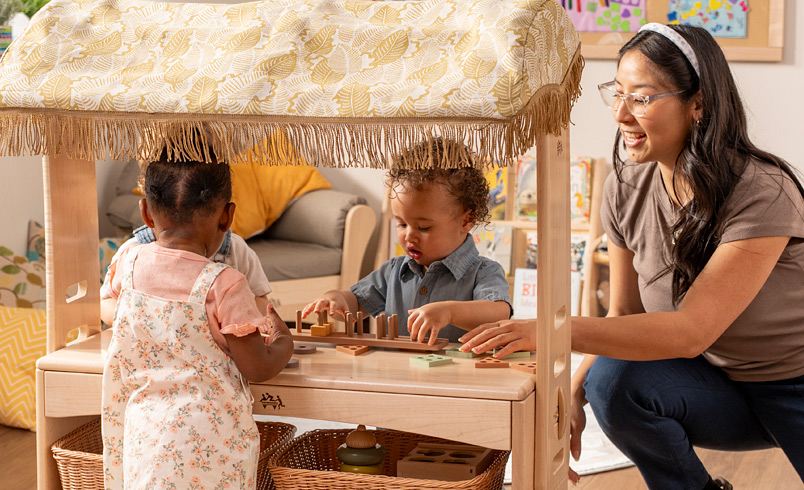
Before offering materials to infants and toddlers, we spend time with the materials as teachers. Holding the materials in our hands and manipulating them helps us understand the possibilities they offer in sensemaking in regard to properties of materials for an infant and toddler. This always involves consideration of sensory input. Intentional teachers organize spaces in their classrooms so that the sensory needs of all children can be met. In these classrooms, teachers consider the developmental level of each child and select materials that can be explored successfully by each member of the group so that even very young children have choices about how they engage with materials. Teachers then observe children as they approach a new experience and take note of the way each child makes discoveries about the materials.

Carefully observing a child handling a new material one may notice the sensory information on which they focus. They may begin by grasping an object, then look more closely as they turn, tap, or drop it. Often, infants and toddlers will find a way to make a sound with the object by shaking it or banging it against another object. Mouthing the object provides even more data for the child to contemplate. Older infants and toddlers will explore ways to use the object in interesting ways such as stuffing it into a container or dumping it onto the floor. Mobile infants will explore ways of moving while carrying the object or will move the object itself by rolling, dropping, or throwing. Early on, senses and motor skills cooperate (Murphy & Moon, 2010) so that children can support their curiosity about the world and objects in that world around them through these experiences.
Sensemaking with Treasure Baskets
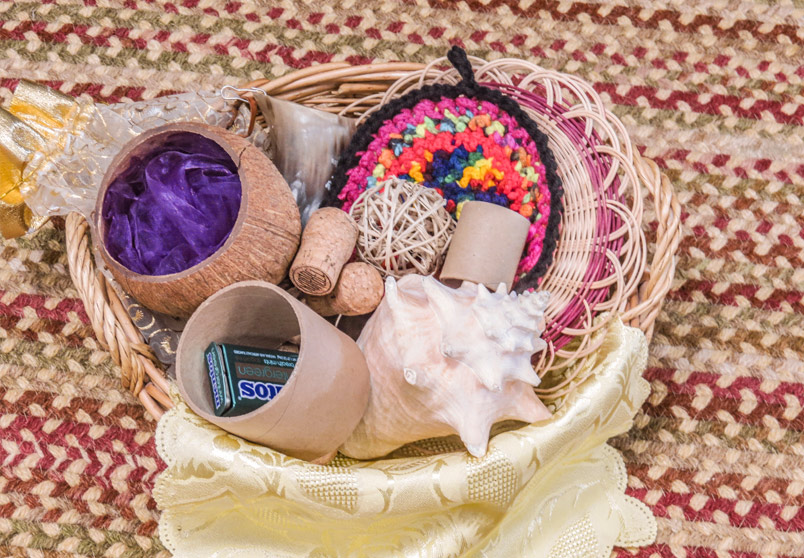
Treasure baskets (Wilhelm, 2017) are one way to encourage infants and toddlers to engage in sensory play. Treasure baskets contain a selection of thoughtfully curated materials designed to entice children to explore and investigate. Some treasure baskets have a theme of sorts, such as items that relate to winter: large white pompoms, glittery ornaments that look like snowflakes, jingle bells, a pair of mittens, or a fuzzy stocking cap. The basket might also contain an indestructible book with pictures of snow, sleds, polar bears, and children tumbling in the snow. Treasure baskets can be thought of as “loose parts for beginners” with everyday objects that can be used in interesting ways. The open-ended nature of a treasure basket means that there is something for everyone when materials are selected to honor what children know and can do or what they are almost ready to do.
Treasure baskets can be designed for individual children or with specific goals in mind. Thinking about our definition of STEM guides us when gathering materials for a new treasure basket. The specific ages of the children in the group will suggest the items you select for children to investigate. Spoons, cookie tins, tongs, measuring cups, a variety of wooden blocks, scarves, ribbon, containers from your recycling bin, tubs with lids, balls that are soft, hard, have textures, and that fit in the containers, or don’t fit, are accessible materials that invite children to use their senses to investigate, solve problems that they devise while playing, and explore what the objects can do. The open-ended nature of these materials will provide interest for children in a wide range of developmental levels.
Many household items and familiar classroom materials support STEM goals and entice children to explore and investigate. Treasure baskets can be both indoor and outdoor experiences for infants and toddlers. Because they are designed to be part of an adult-supported experience, natural materials can be selected so that children can investigate the natural world with just the right amount of risk.
Sensemaking in Block Play
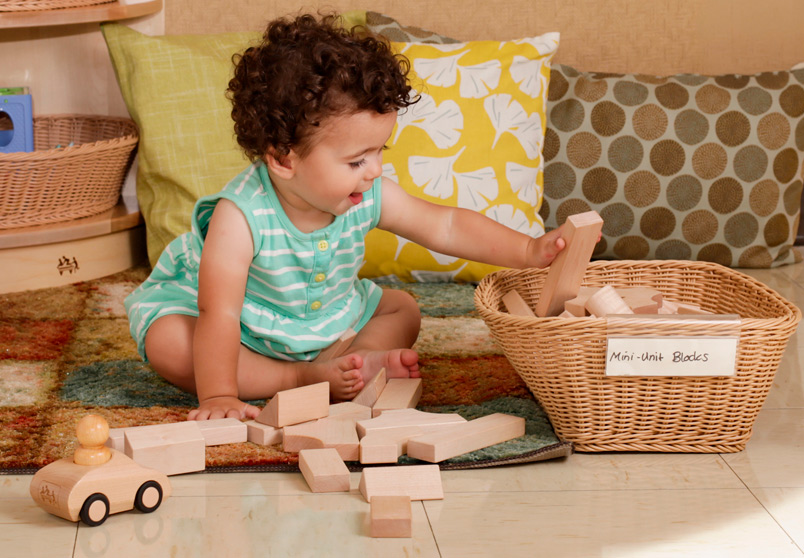
Including unit blocks and mini unit blocks in infant and toddler classrooms is a way to honor what even very young children know and can do. Even seasoned infant and toddler educators can be surprised by what children with access to these rich materials can create!
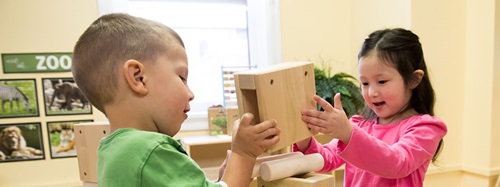
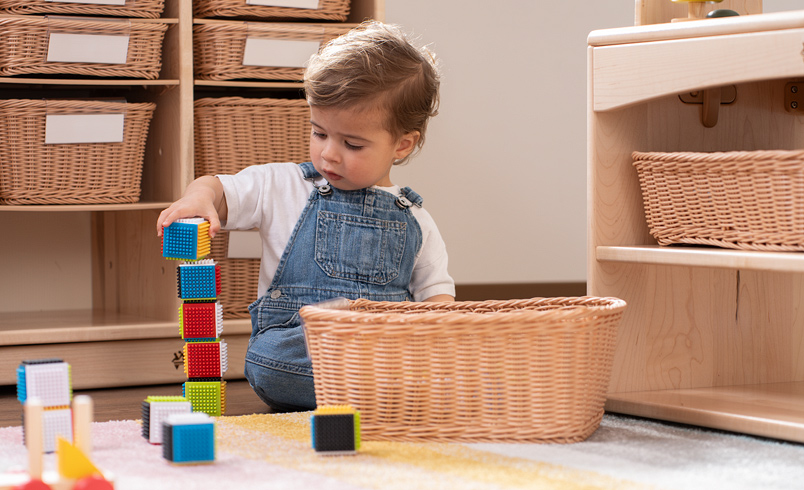
Blocks are the kind of classroom material that will entice children of any age to explore and investigate. These timeless materials are the quintessential loose parts with no end of potential for STEM-rich play. Open-ended play materials such as wooden unit blocks allow children to make choices, express their creativity, and support their independence. We often introduce mini unit blocks to infant and toddler classrooms first and marvel at the way these blocks fit perfectly into a baby’s hands and respond to a child’s desire to make something interesting happen. Even children who are not yet sitting are curious about how they can make a stack of mini unit blocks topple over with a “bang” when they move their arms or legs. Unit blocks are ripe with possibilities for science, technology, engineering, and math play.
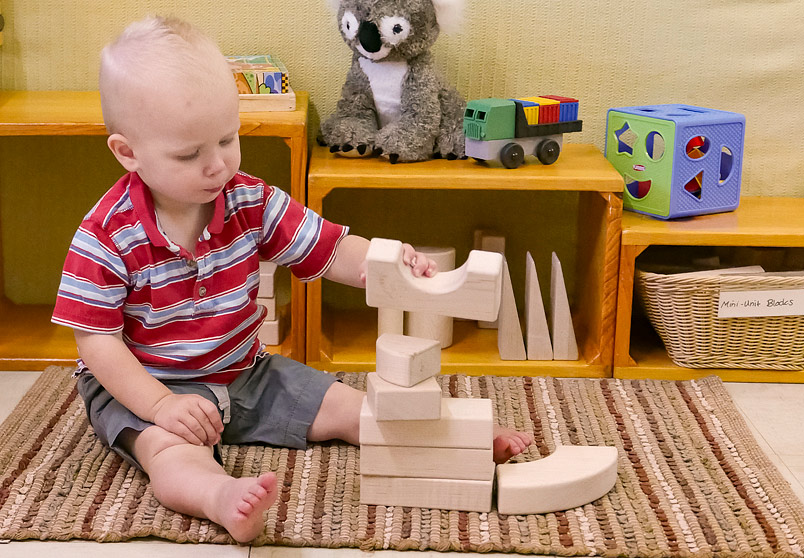
“Block play transcends all forms of infant-toddler play and supports all domains of development” (Wellhousen & Kieff, 2001, p. 65). Children strengthen cognitive development when they pursue a task such as building a tower and persist in this task even after several iterations prove unsuccessful. As children build, they increase their development of social-emotional regulation while building in close proximity to other toddlers and using the same set of blocks. Building provides many opportunities for children to engage in interactive exchanges that support both emotion regulation and language development. Vocabulary is enriched when adults label blocks and props during interactive play or assist children in conflict negotiations that occur while building together. They gain a working understanding of the science of balancing one block on top of another, and how the properties and placement of a block impact its stability when stacked. Spatial ability is an important math outcome that is supported in the block center when children use trial and error to choose blocks of different lengths and widths to pursue a building goal or when they realize that the space they have for building does not support the idea they have in mind. There are additional math concepts that children encounter while building including more/less, sorting, patterns, numeracy, shape, size, measurement, and symmetry. There are opportunities for creativity when selecting materials, finding props, and describing what they are building. As children have more experience with blocks and building materials, the structures often take on aesthetically pleasing forms and children are excited about finding paper, jewels, and natural materials to decorate their work.

Finding the Sweet Spot
It is important that educators engage in teacher play with materials and plan complex experiences with an intentional selection of open-ended materials with just the right amount of challenge to nurture the development of STEM learning dispositions. Lewin-Benham (2023) tells us that intention is possibly the most important aspect of a teacher’s behavior. Providing open-ended materials that address all of the components of STEM, using observations and documentation to make curricular decisions, and understanding the importance of relationships is intentional teaching. Finding that “sweet spot” for each child encourages them to use old strategies and to develop new strategies for finding the answers to their self-imposed questions. When children have multiple experiences with the same materials over time, we often see a sort of resolution to the problem children have set for themselves. Our observations about what children do with carefully selected materials when adults provide just the right amount of support is that they often use materials in creative and interesting ways. Intentional selection of materials results in children exploring materials and making predictions based on observations (science). They use the materials to invent tools and build (technology). They solve problems in building with a variety of materials with different properties (engineering). They engage with measurement, sequencing, patterning, and shape as they work with open-ended materials (mathematics). These babies do STEM.
Resources:
Brownrigg, J., Carey, C. & Fredericks, B. (2013) STEM Sprouts: Science, Technology, Engineering, & Math Teaching Guide. Boston Children’s Museum.
Hirsch, E. S. ((2006). The Block Book, 3rd Edition. NAEYC.
Iowa Regents’ Center for Early Developmental Education (2026, April). “STEM Experiences for Classrooms: Infants & Toddlers.” Regentsctr.uni.edu/educator-resources/stem-experiences-classrooms
Murphy, L. B., & Moon, R. (2010). “Sensory experience and development in babies.” Edited from the Zero to Three Journal.
NAEYC. 2020. “Developmentally Appropriate Practice.” Position statement. NAEYC. https://www.naeyc.org/resources/position-statements/dap/contents
National Scientific Council on the Developing Child (2007). “The Timing and Qquality of Early Experiences Combine to Shape Brain Architecture: Working Paper #5.” http://www.developingchild.net
Piaget. J. (1967). The Child’s Conception of Number. W.W. Norton.
VanMeeteren, B., & Peterson, S. (2022). Investigating STEM With Infants and Toddlers. Teachers College Press.
Wellhousen, K., & Kieff, J. E. (2001). A Constructivist Approach to Block Play in Early Childhood. Delmar/Thomson Learning.
Wilhelm, L. (2017). Treasure Basket Explorations: Heuristic Learning for Infants and Toddlers. Gryphon House.