Stonework Play
A Gift of Kindness
| March 2026"Stonework Play is really just an invitation to work with stones, just an invitation to get back to nature, to be in the present and see how creative you are."
—Dr. Diana Suskind
Introduction
In my many years in early childhood education, I've seen trends come and go—some thoughtful, some questionable, and some that missed the mark entirely. It is rare for an approach to feel both profoundly simple and deeply transformative.
Stonework Play is one of those rare practices.
Created by Dr. Diana Suskind, Stonework Play meets children exactly where they are. It invites them into presence, creativity, collaboration, and self-kindness—using nothing more than stones and time.
How Stonework Play Began
In 2011, Diana traveled to Nepal as an Early Childhood School HEMS (Health, Education, Maintenance, and Support) consultant. Upon arrival, she discovered that supplies were scarce and that the curriculum consisted of children repeating what a teacher said and engaging in rote learning. She realized that children strongly needed a way to express themselves, so she aimed to develop an engaging curriculum that would spark their curiosity.
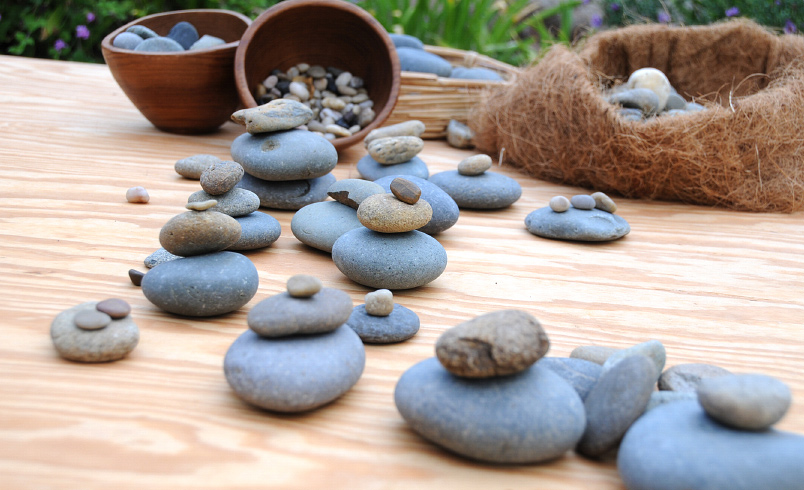
One day, while walking outside, Diana noticed stones everywhere and became interested in using them to teach. After obtaining the teachers' permission, they wrote a letter to the parents and involved them. To begin, the children collected stones with their parents. The children were fascinated by the stones, so Diana used them as the core part of a new learning experience, Stonework Play.
Stonework Play reminds teachers: (1) to observe the children, (2) to make sure the activity is relevant to the children's environment, (3) that nature is powerful, and (4) that children learn by having ample time to play.
The Five Steps of Stonework Play
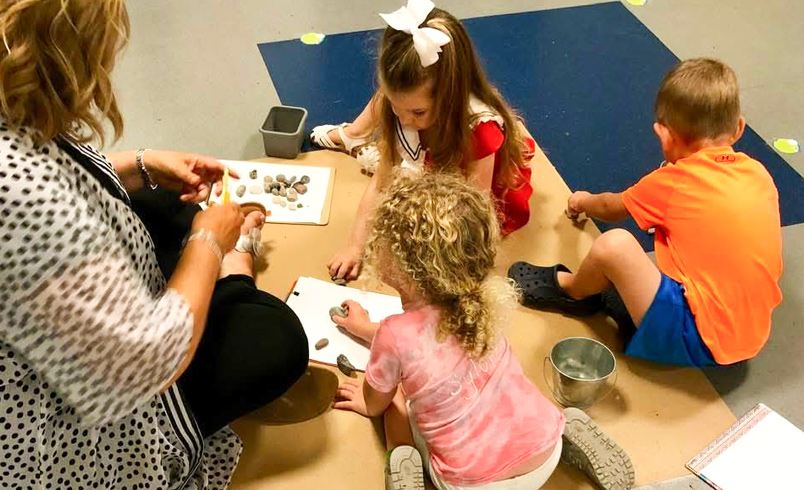
The following is a brief overview of the five steps carefully and purposefully developed for Stonework Play. The children will participate in:
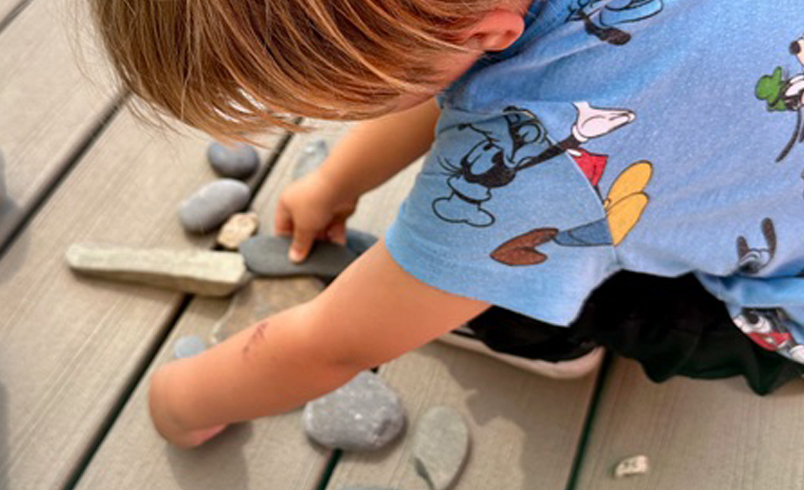
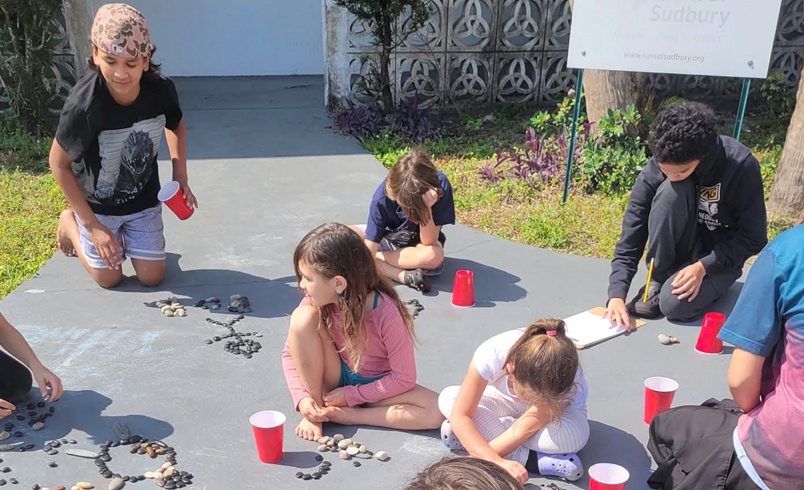
Gathering—Choosing the stones they want to work with, by themselves or with others, and then sorting them in a way that makes sense to them.
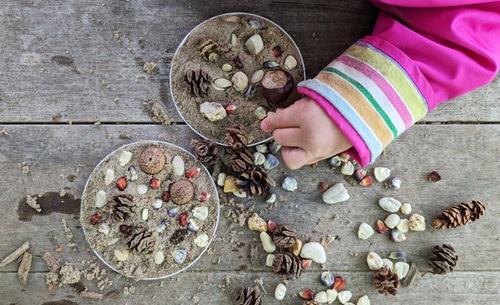
Constructing—Moving the stones around and building something from what they “say” to the child.
Rendering—Intently observing what they have constructed and then capturing it with paper and pencil.
Narrating—Writing the story represented by their construction. (Very young children may tell their story to an adult who will write it down for them.)
Sharing—Telling their story to the group, and listening to others’ stories.
The children are given ample time to go through these steps at their own pace. One result is that some children may be in the sharing step, while others are working through earlier steps. To minimize any distraction this could cause, children who wish to show appreciation for another’s sharing will wave instead of clapping.
A major benefit of giving children ample time to take these steps at their own pace is that it helps them become thoroughly engaged.
How these steps unfold will vary with each individual child at her level.
I’ve seen the same engagement from adults doing this activity. Here is my journal entry after doing Stonework Play with educators, to train them in it:
The participants engaging with the stones seemed mesmerized by what they were doing. Everyone looked purposeful, and there was a sense of contentment in the environment, a quality often lacking in today’s curriculum. It was clear that the individual’s work became important and that nature became valuable. Two people asked me if they could have a stone. Imagine that! Like me, they were probably used to ignoring stones.
Throughout the five steps, “Tarry Time” can occur. Diana defines this as “the amount of silence between interactions. This silent space is fertile ground for creativity, and Stonework Play supports it. Further, silence is well known to be inspired by nature.”
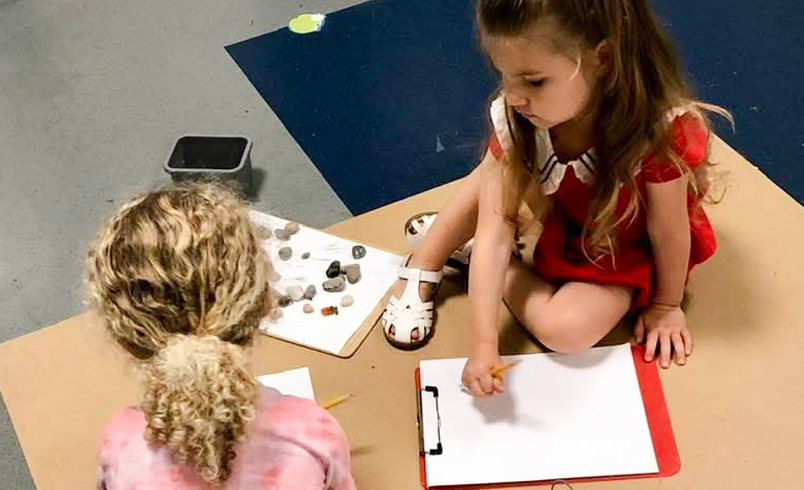
All too often, though, adults don’t allow children to have their Tarry Time and, instead, try to push things along at their own pace. An example of a missed opportunity for Tarry Time would be if a four-year-old, Danielle, is concentrating on capturing her construction (Step 3, Rendering) and lays down her pencil for a bit. An adult sees this, comes over, and immediately asks if she wants to write her story now and hands her a pencil. By not waiting to see if Danielle is still studying her construction and working hard to capture it on paper, or even waiting for Danielle to reply yes or no (verbally or nonverbally) to her question, the adult has interrupted Danielle’s Tarry Time.
Upon completion of the five steps, the children are invited to take home one stone from their construction. This stone becomes a strong transition item for leaving Stonework Play. Then, when logistically possible, the children return the remaining stones to where they were found, so that the ecosystem is restored.
Child Development Benefits
Stonework Play provides a multitude of child development benefits. The three discussed in this article are: (1) self-kindness, (2) collaborative play, and (3) appreciation of nature. These are of utmost importance in today’s push to succeed in the world, where children spend too much time with technology, too little time in free play, and too little time in nature. Plus, there is often not enough time for them to work together and learn to get along. Please remember that these three benefits are NOT the result of the children being “taught” about them in an authoritarian manner, where the teacher has complete control; rather, children explore and learn in a natural, authentic way. In Stonework Play, self-kindness, collaborative play, and appreciation of nature often occur simultaneously.
Self-Kindness
All five steps of Stonework Play support self-kindness. For instance, in Step 2 (Constructing), children deeply engage in their constructions, which offers them an opportunity to be present with themselves, without interruption, and to make their own choices. This autonomy lays a foundation for building self-kindness.
Stonework Play provides children with both an environment and the elements of nature that support each child in being kind to themselves by giving them a chance to be what I call my “6 Cs”: calm, community builders, connected to nature, creative, curious, and confident. Importantly, this begins without prescribed lessons that provide few choices for them.
This encouragement and support of self-kindness, recommended by experts in both psychology and early childhood, is often lacking in today’s busy world.
Researcher and author Kristin Neff outlines both the importance of self-kindness and the problems that may arise for people who do not develop it. Neff defines self-kindness as offering oneself soothing comfort. Self-awareness during the present experience is essential for this. Common humanity involves recognizing that all humans, including oneself, are imperfect and make mistakes.
I wonder, do we typically give a child ample time at school or at home to feel comfortable and be present with themselves?
If we are not giving children a chance for self-kindness, are we in danger of the negative consequences Neff points out in the article, such as mental illness?
Collaborative Play
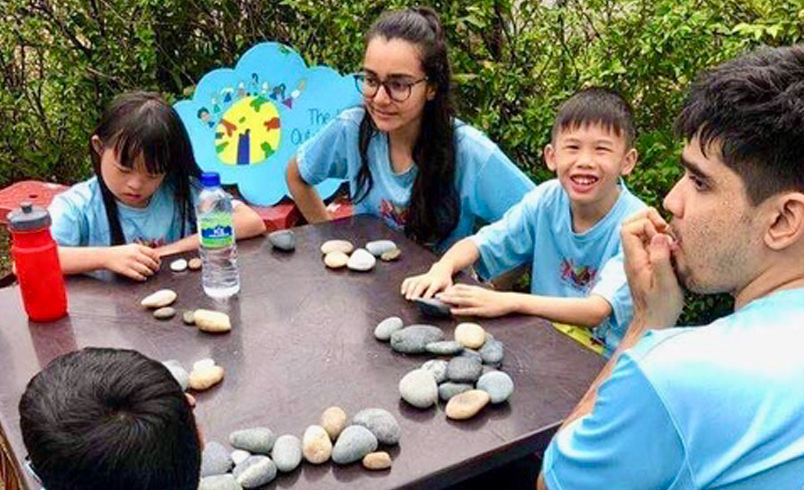
Self-kindness is a foundation for collaborative play. For example, how can you share your stones if you do not feel that there will be any left for yourself? Furthermore, collaborative play happens throughout ALL five steps. The children may seem occupied with solitary play, but collaborative play is occurring simultaneously. This is because Stonework Play instills a sense of community even when children are playing alone. In Steps 2, 3, and 4, while the children work silently, a large group surrounds them. The environment conveys that this is a safe place for them to work, both privately and with the community present.
Diana mentioned to me that she is struck by how children are in tune with and respectful of the large group, even when they are doing the activity alone, and throughout all the steps, the sharing of stones still goes on. In addition, Diana told me that in over 15 years of Stonework Play with thousands of groups, she has never seen a child throw a stone; rather, children use them purposefully in this activity.
Here is another of my journal entries, from when I did Stonework Play with educators to train them in it, showing how they also began to bond as a group while doing Stonework Play:
Everyone was unfamiliar with one another. Yet, I saw trust and respect between them as they shared personal details. This was quick. My participants were of different ages and from various locations, yet they were all attentive and seemed trusting in one another. The body and facial language seemed both relaxed and empathetic.
In addition, collaborative play typically involves expressive language (the language used to communicate with others). When you look at the five steps, you will see explicit examples of this: writing the story, telling the story, listening to others tell their stories, and waving to show appreciation after hearing each story. Thus, language skills are embraced in Stonework Play.
Appreciation of Nature
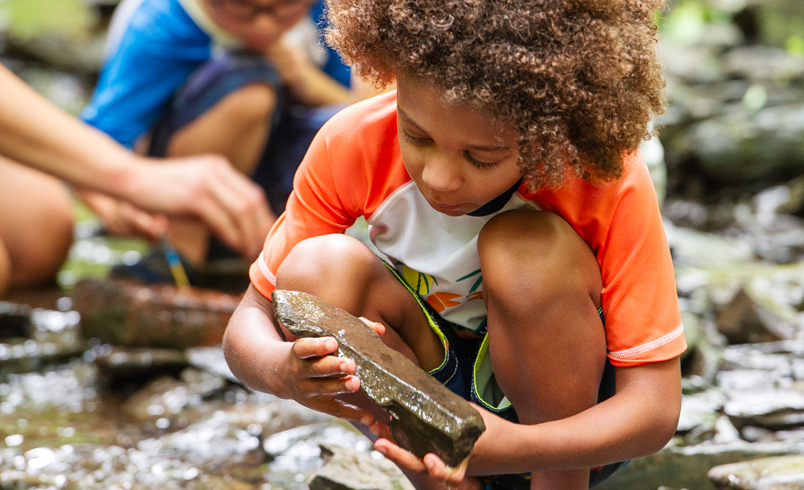
In Stonework Play, children reconnect with the earth and treat it well. It also encourages ecological restoration and preservation. Thus, Stonework Play supports children in the beginning steps of appreciating and creating a healthy ecosystem.
Diana is fond of saying, “A stone is a stone, a child is a child, and each one is different.” She has seen that this fosters an inclusive community and strengthens connections.
Stones come in a variety of shapes, colors, textures, and sizes, and some stones may even be broken. Thus, they help children consider both similarities and differences. This supports children's inclusion and diminishes ableism, racism, and ageism by fostering respect and empathy and encouraging self-kindness and kindness toward others.
Plus, there is something about the physicality of stones that captivated me. There is a different sensory aspect to nature. Touching nature (in this case, stones) provides deep sensory feelings. This is valuable for children with a variety of learning styles, but I have also seen adults respond positively to the feel of the stones. Even when I did a practice round of Stonework Play with my family, this surprised me:
My daughter and husband have tried out workshop activities with me before, and they were “thrilled” (not). This activity was different.
The stones surprised me. I never expected them to stay with the activity so long. We all got lost in the stones. When we were sharing our stories, each of us was fondling a stone that wasn’t part of our construction. Who knew a stone could be so comforting?
Outside play has benefits in all sorts of environments. In fact, Diana is now working on extending Stonework Play to be done on grass, snow, and even in water.
Conclusion
Since inventing Stonework Play over 15 years ago, Diana continues to share her knowledge around the world. Stones are a natural feature everywhere, and their attraction seems universal.
One thing that brought this home for me was speaking with Anne Sivanathan, the president and founder of the Association of the Inclusive Outdoor Classroom in Malaysia. It serves children aged 4-15, and about half have special needs. Ann has noticed that since the introduction of Stonework Play 15 years ago, the students have become calmer and more self-expressive.
Stonework Play helps children have more choices. In Diana’s words: “Stonework is the open-ended response to the invitation to work with stones, a natural resource. Inspiring participants in storytelling, stones are a kinesthetic medium never fixed in their place or meaning, the ground an endless canvas, and small hands the brushes that move them.”
This is such a different experience from what Diana first encountered in Nepal, and from what is often a big piece of the prescribed curriculum in the United States. A prescribed lesson for young children may typically include activities such as labeling items, responding to a question such as “what is your favorite animal?” or tracing over letters of words.
Instead, in Stonework Play, children become absorbed in their work, and a variety of stories blossom. Their imagination stretches as they explore their own ideas. Stonework Play is open to whatever the child imagines, whether it’s an erupting volcano or a butterfly stuck to a flower. Their fertile minds lead to endless possibilities. This opens the door to self-esteem and social skills, thanks to the power of these natural materials.
References
The Elizabeth Jarman Foundation and Diana Suskind. Stonework Inspires Storytelling. 2012. Accessed May 5, 2026. https://dsuskind.com/images/Publications/Executive_Summary.pdf
Neff, Kristin. Self-Compassion: The Proven Power of Being Kind to Yourself. New York: William Morrow, 2011.