
Designing Child-Centered Early Childhood Environments in the Public School Setting
| January 2026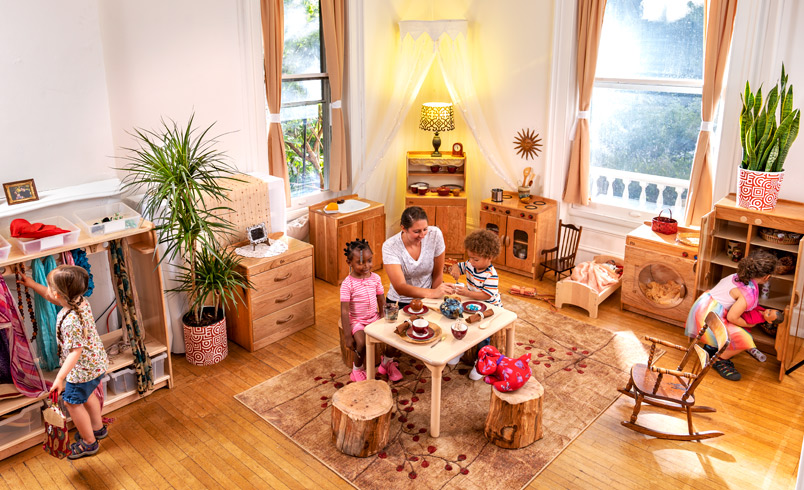
In education, we sometimes talk about pendulum swings. Beliefs, practices, and content that were held as gold standard just a moment ago shift, then seemingly shift back again. We live in a world where we have to navigate new mandates, assigned trainings, and curriculum expectations that shape our daily work.
It is interesting to pause, then, and consider how we can examine our core beliefs about children and hold onto them. These beliefs are the foundation of our practice, yet sometimes we only take cursory glances at them or include them on an opening slide of a PowerPoint.
What do we believe about children, and how does that manifest in our schools? At times, there can be tension between what we believe and the initiatives or structures we are asked to embrace. Naming and reflecting on those tensions is an important part of ensuring our beliefs continue to guide our work.
One idea that can help us think about these dynamics comes from John Bell in 1995 and his description of adultism. This term highlights the ways that adults’ needs or perspectives can sometimes take precedence—often unintentionally—because of the unquestioned assumption that the young are inferior to the adult.
Maybe you, like us, recoil from that idea, thinking well that does not describe me! And it may very well not! Still, in education, because of our constant proximity to children, we can find ourselves working within systems, structures, or expectations that tilt in this direction. By naming it, we create opportunities to ensure that our decisions consistently elevate children’s voices, needs, and rights alongside the many other priorities we balance.
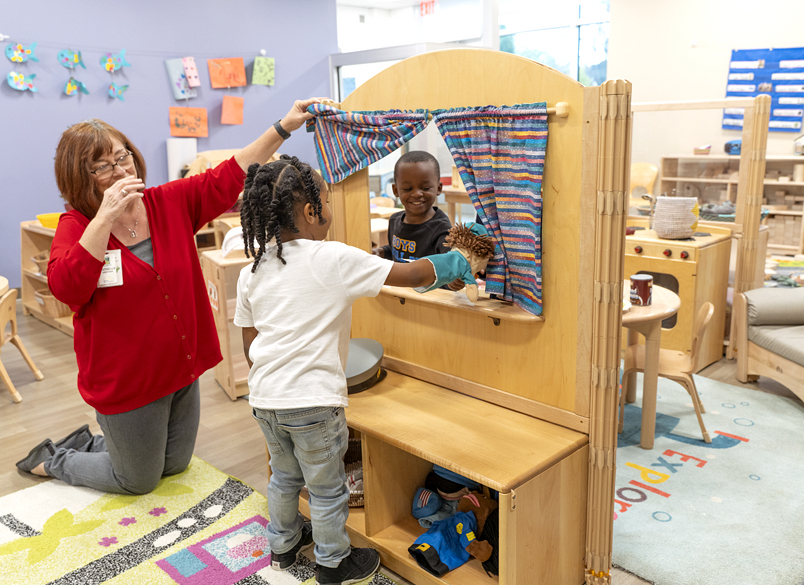
What are the signs and symptoms of adultism?
Some examples of adultism in early childhood and early elementary spaces might be:
- Hyper-regulated access to the bathroom, water or food (for children and teachers)
- Priority in scheduling given to adult needs (e.g., changing a literacy time to the end of the day so the interventionist can be in the room)
- Referring to children’s play in derogatory or minimizing terms (“just” playing)
- Materials inaccessible to students without an adult
- Space and schedule designed with whole class instruction in mind
- Prioritizing seatwork over movement and exploration
- Teacher desk occupying a large area of the room
Now this is not to say that children have the same experiences as adults. Children need materials, routines, and systems that support their developmental stage. However, children have the same right to dignity that we offer unconditionally to adults. John Bell offers an interesting series of questions to self-assess our actions as adultist:
- “Would I treat an adult this way?”
- “Would I talk to an adult in this tone of voice?”
- “Would I grab this out of an adult’s hand?”
- “Would I make this decision for an adult?”
- “Would I have this expectation of an adult?”
- “Would I limit an adult’s behavior this way?”
- “Would I listen to an adult friend’s problem in this same way?”
How do these questions sit with you? How do they sit with the trainings, mandates, and curriculum that have recently come your way? How have the decisions that cascade from curriculum and mandates manifest in room environment? Is the screen suddenly the focal point of the room? Do we go back to desks from tables to store all the “stuff”?
Reclaiming Your Beliefs Through Your Classroom Environment
In a world that often starts with the default belief that children need to earn their way into responsibility, agency, power, and dignity, we can begin to upend this mindset with simple changes in our spaces and how we teach in those spaces. This doesn’t mean that children have free reign in a boundaryless environment. With rights come responsibilities, and children are supported by systems and routines that set limits and support exploration and play in an amiable environment.
Here are some tips for shifting the classroom environment from one that centers adults to one that centers children:
Honor Play as Learning by Creating a Variety of Places and Using Flexible Materials
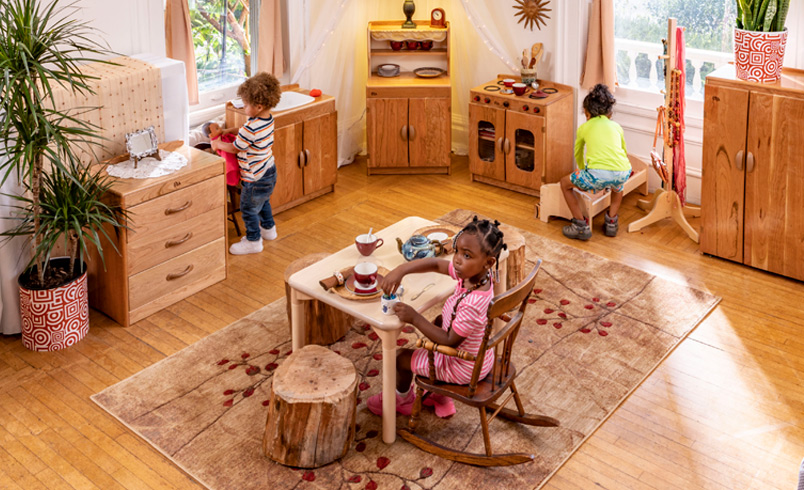
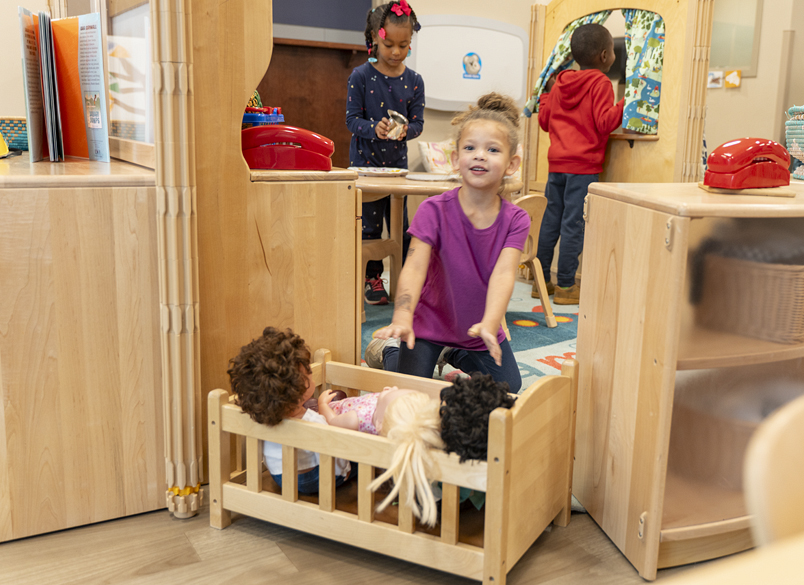
Defined zones: Design the room with distinct areas. You might consider creating areas with blocks for construction, other areas for dramatic play, art, science, and a quiet library. That way, children can choose how to play and work in different areas of the room based on their interests and needs. We’ve seen first grades with play kitchens and third grades with a puppet theater. A variety of spaces also helps a class transition from a whole group book on the rug to small groups or partnerships working around the room. With support, children can pick the spaces that best meet their needs and interests, but we reflect on how to maintain a child’s right to make choices that work for them and their community.
Flexible furnishings: There is no hard-and-fast rule that says where you put the tables in August means they need to be there in January. Furniture can adapt based on the kind of play or learning children are engaged in. Perhaps a large group of children has started to write Minecraft stories together and need a low table with plenty of space and some pillows on the floor to create a writing community together. The more flexible your furniture, the more adaptable it can be to what the children are doing.
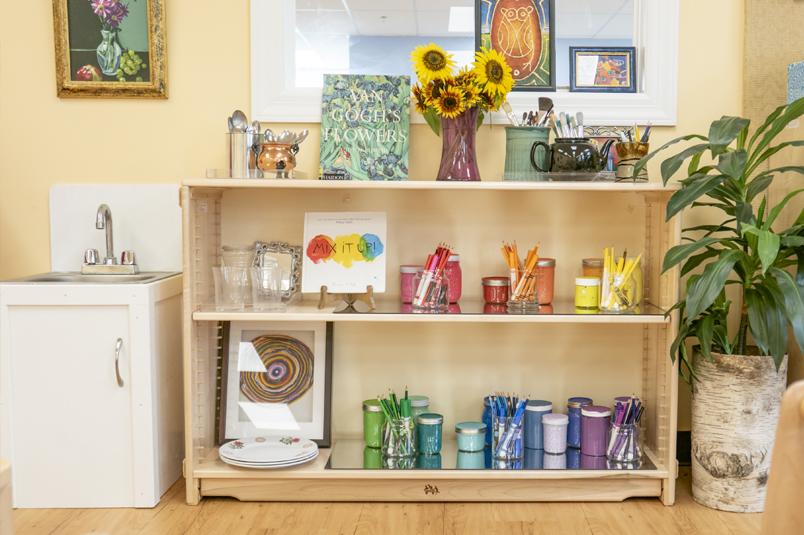
Natural and open-ended materials: Flexible materials such as loose parts, small stones, fabric, and blocks invite children to invent, combine, and transform. At one moment small felt balls might be used as ingredients in a soup and the next as manipulatives in a math equation. Create systems for keeping these items organized and accessible to children like keeping them in small plastic jars with a picture of what goes inside on the outside. As a class, you can decide what materials go where and what degree of flexibility they can have. Can the wooden rings travel from the art center to dramatic play? Do all of the blocks stay in the construction area? When they are finished with a certain material, children can take responsibility for sorting them back into the containers and returning them to their homes.
Reflect the Children’s Agency, Interests, and Identities in the Environment
Walls as mirrors: Display children’s photos, names, and family and caregiver artifacts at their eye level so they can see themselves represented daily. We like to try to aim for the 90-10 rule. Ninety percent of what is on the walls reflects the children (their photos, their artwork, their work), and ten percent is teacher-created or teacher-focused. We’ve seen teachers use children’s photos as puzzles, to create a visual schedule for the day, to label cubbies, mailboxes, and as paper dolls in small-world play.
Choice-filled shelves: Organize materials so children can independently access books, art supplies, and building tools that reflect a wide range of cultures, identities, and experiences.
Rotating centers: Curate materials and books around current children’s interests. If children are fascinated with worms, add magnifying glasses, worms in an aquarium, and nonfiction texts to the science shelf. If the Titanic is a hit in your classroom, you might have cardboard, foil, and recyclables to create truly unsinkable ships and plenty of books, clipboards, and graph paper for design work.
Make Learning Visible
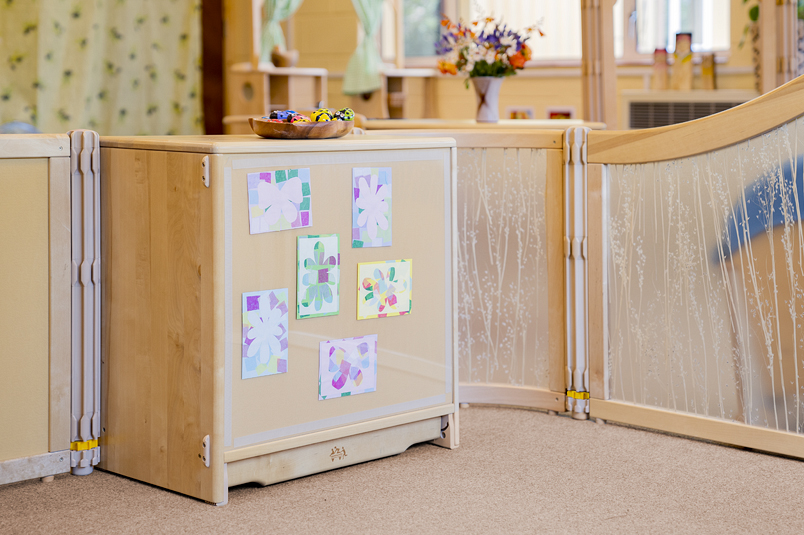
Displays: Perfectly curated crafts and bulletin boards are often exactly what adults want to see, but they don’t truly reflect children’s learning and creativity. Instead, you could put up simple displays that show children’s processes: photos, sketches, and works-in-progress. That way, their thinking, not just final products, can be highlighted.
Interactive boards: Dedicate a wall or easel to questions children are exploring and add evolving child contributions. This area could be close to your meeting area so you can add to it during whole class conversations. If you’re investigating weather, children could record their observations, questions, and discoveries with photographs and words.
Children’s eye-level photographs: Visuals that are low and where children can easily revisit them can spark reflection and new connections. Images of what’s possible in the block area, the way a child solved a challenging math problem, or a quick snapshot to demonstrate how a partnership solved a problem can serve as visual cues for children and can make it really feel like their classroom.
Conclusion
Embracing playful learning, flexible spaces, and child-centered classrooms means that we are meeting children exactly where they are. We are not trying to sculpt them into mini adults or have them conform to our idea of what a four-, six-, or eight-year-old should be like. Instead, we are seeing them as capable and curious members of a learning community with their own rights and responsibilities. From there, we see what magic unfolds.


