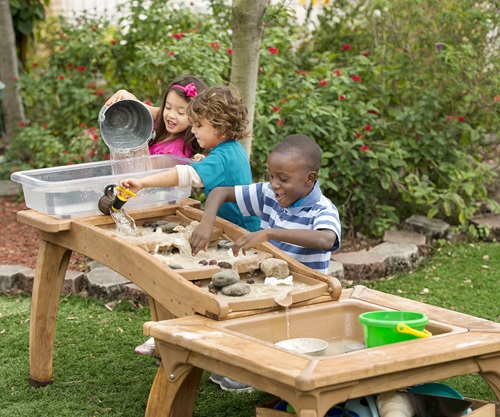
Early Literacy in the Outdoor Environment
| February 2026"In the outdoor classroom, phonics comes alive: the sounds of the natural world become the syllables of our stories, making abstract letters concrete through the simple touch of earth and air."
—Amy Reyes

Early literacy, particularly through effective phonics instruction, provides much more than a head start in school; it fundamentally shapes a child's cognitive, social, and emotional development for life. While traditional indoor classrooms are essential, the outdoor environment offers a unique, dynamic setting that significantly enhances these foundational skills.
The Broad Impact of Early Literacy and Phonics
Phonics, the understanding of the relationship between written letters and spoken sounds, is a critical component of reading acquisition. Strong early literacy skills impact a child's development in several ways:
- Cognitive Function: Reading proficiency strengthens critical thinking, problem-solving, and information processing abilities.
- Academic Success: Children with strong literacy skills are more likely to succeed in all academic subjects, not just English language arts.
- Emotional Well-being: The ability to read empowers children, boosting their self-esteem and fostering a sense of independence and curiosity.
- Lifelong Learning: Literacy is the gateway to continuous learning, enabling individuals to access information, explore new ideas, and engage fully in society throughout their lives.
The Outdoors as a Unique Literacy Classroom
The outdoor environment naturally supports literacy development by providing rich, multi-sensory experiences that engage children's curiosity and make learning tangible and exciting. The unpredictability and openness of outdoor spaces encourage exploration and communication in ways static indoor environments often cannot. The physical act of exploring the environment and the excitement of discovery make the learning process engaging and memorable, fostering an intrinsic motivation to learn and use language in a real-world context.
I can teach a lesson on dams through traditional instruction, or I can allow the children to build dams in a stream. I can tell you the hands-on experience will prove to be a more meaningful experience for learning how dams work. When children engage in building activities, the experience is often more meaningful due to the integration of physical manipulation, problem-solving, and concrete results. Unlike abstract learning where results might be invisible (like memorizing facts), building produces a visible, tangible object. This immediate feedback loop allows children to see the direct consequence of their effort and planning. Just as building a dam makes the concept physically real and tangible, these hands-on moments create the robust sensory and cognitive conditions necessary for abstract linguistic concepts like phonics to take root and flourish.
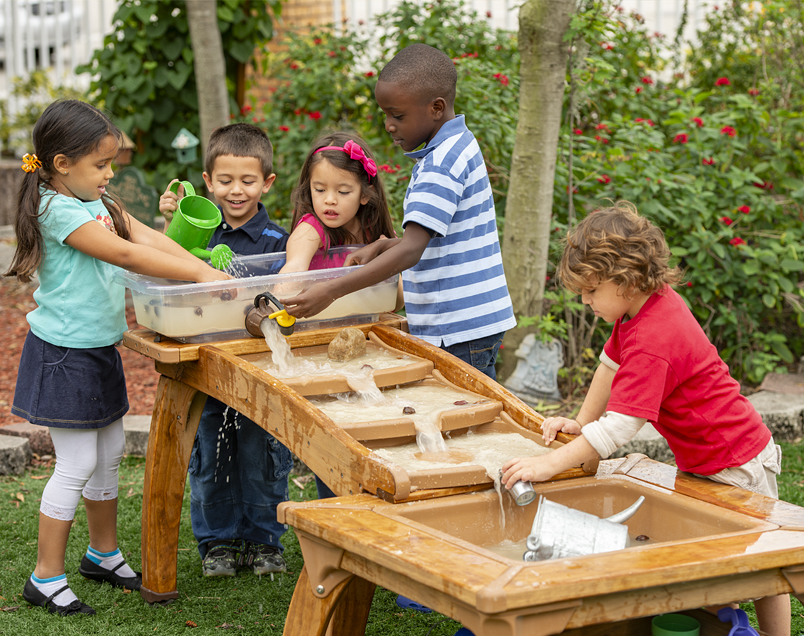
Three Ways Outdoor Learning Strengthens Literacy
1. Sensory Engagement and Language Growth
Nature engages all the senses: the smell of pine, the sound of crunching leaves, the feel of rough bark. This sensory richness provides a wealth of new vocabulary. Children are naturally motivated to describe their observations, leading to spontaneous conversations and a deeper understanding of language.
Example: A teacher takes children to explore a mossy log in a wooded area. One child touches it and exclaims, "It's all squishy!" The teacher responds, "Yes, it's very squishy—that's a great word for how damp and spongy the moss feels." Another child, feeling nearby bark, adds, "But this part is super rough! It's like my cat's tongue." This leads to a comparative conversation using "rough," "smooth," and "bumpy." When discussing the smell, one child suggests, "It smells like where the worms live," which the teacher affirms as "earthy."
Through this simple interaction, children aren't just hearing new words; they're physically experiencing the concepts those words represent. The concrete, sensory input provides immediate context, making the vocabulary more meaningful and deeply understood than if the teacher had merely shown a picture of "moss" in a classroom.
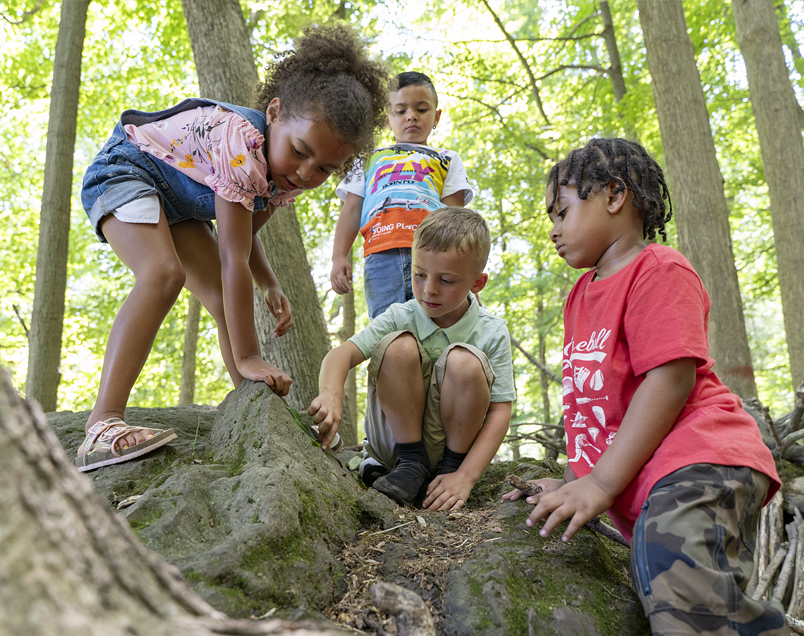
2. Contextual Learning and Comprehension
Reading about a "habitat" inside is abstract; observing a bird's nest or a log teeming with insects outdoors provides a concrete, real-world context. This direct experience deepens comprehension and allows children to connect words to tangible objects and events.
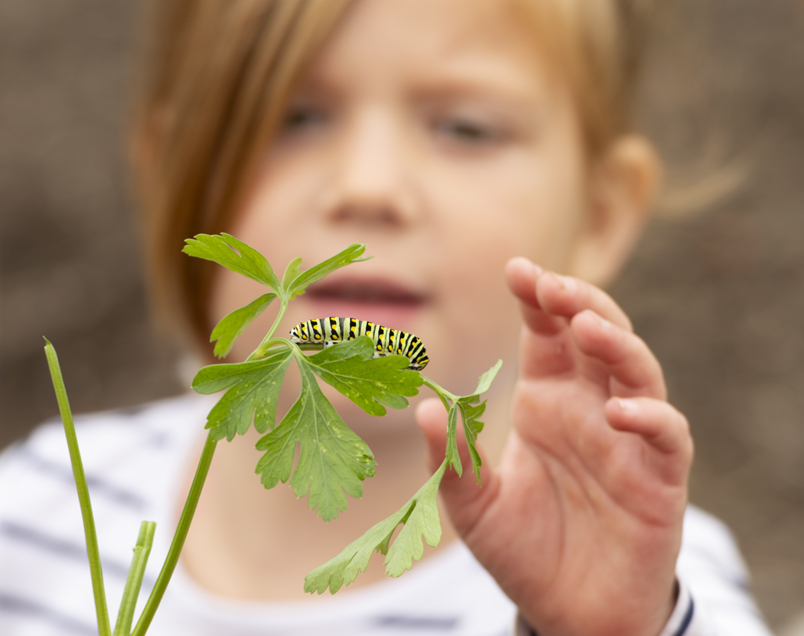
Example: Compare learning about a butterfly's life cycle indoors versus outdoors. In a classroom, a teacher might use a chart with pictures and have children complete a worksheet. While learning occurs, the experience is largely passive and conceptual. Outdoors, children discover a small green caterpillar munching on a milkweed leaf. A child points and shouts, "It's eating!" When the teacher says, "This is the larva stage of the butterfly's life cycle," the vocabulary is immediately anchored to the living creature they're observing. The words (caterpillar, larva, life cycle) are tied to a real-world, living object rather than just a picture. The surprise and excitement of discovery create an emotional memory that solidifies both vocabulary and biological concepts.
3. Collaborative Play and Language Processing
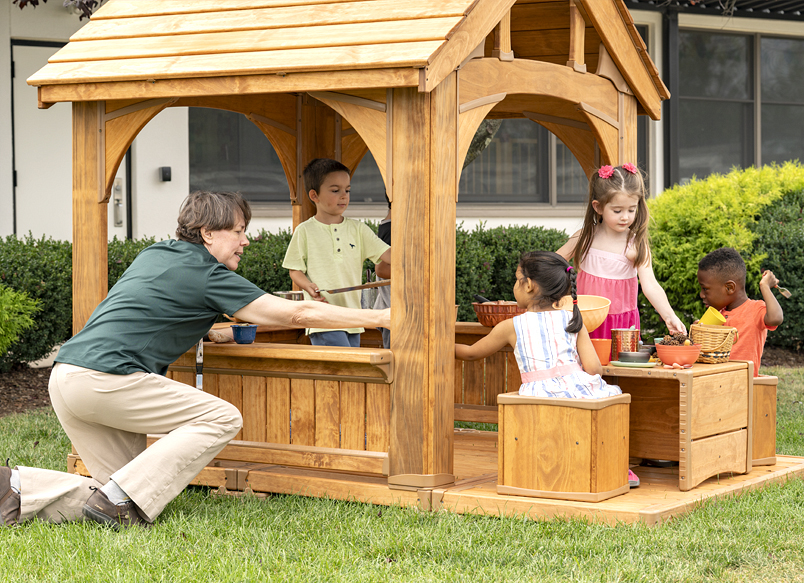
The diverse and dynamic environment of outdoor dramatic play—from a bustling "mud kitchen" to a collaborative "construction site"—is more than just fun; it is a critical setting for building the complex language skills that directly underpin phonics and early literacy development.
When children engage in scenarios like running an "outdoor bakery," they enter a world that demands high-level social coordination and explicit communication:
- Negotiating Roles and Rules: "I'm the baker, you take the orders." This negotiation requires clear articulation, active listening, and shared understanding—foundational communication skills.
- Sequential Storytelling: The play follows a dramatic arc with a beginning, middle, and end, which directly builds comprehension skills necessary for following narrative text.
- Vocabulary Expansion: Open-ended outdoor materials prompt children to use precise vocabulary: whisk, ingredients, receipt, structure, blueprint, hoist, purify, campsite, attendant.
Children naturally adopt roles inspired by their environment:;
- Veterinarian or Wildlife Rescue Center: Using stuffed animals or observations of insects and birds, children set up a "clinic" under a tree, using leaves as bandages and sticks as stethoscopes.
- Park Rangers or Ecologists: Equipped with clipboards and magnifying glasses, children document "animal tracks," monitor tree health, or clean up litter to protect the "park."
- Construction Site: Building a fort requires children to explain ideas ("Put this box here for the door"), negotiate challenges ("No, that won't hold the roof up"), and collaborate on design.
- Botanists/Gardeners: Children engage in planting "seeds" (pebbles or acorns), "watering" plants with watering cans, and harvesting imaginary crops. This can easily be linked to a real garden project.
The transition from spoken language to print becomes natural within these scenarios. Drawing "blueprints" with chalk connects design ideas to visual, symbolic representation, mirroring the link between spoken words and written letters. Creating "menus" or "labels" for the bakery involves invented spelling and reinforces the alphabetic principle.
Strategies for Educators in the Outdoor Classroom
These approaches translate naturally into outdoor learning activities. Educators can seamlessly integrate literacy and phonics instruction into the outdoor environment using engaging strategies such as:
- Nature Alphabet Hunts: Challenge children to find natural objects that resemble letters of the alphabet (e.g., a curved stick for 'C', two straight twigs for 'A'). This activity sharpens phonics awareness while fostering observation skills.
- Storytelling Walks: As you walk through a garden or park, collaboratively create a story. Each child adds a sentence inspired by something they see, using descriptive language and new vocabulary.
- "Sound Detectives": Encourage children to sit quietly and identify different sounds in their environment (birds chirping, wind blowing, cars passing). Write down the words that describe these sounds and practice the corresponding letters and sound-letter relationships.
- Natural Writing Tools: Use sticks to "write" letters and words in the dirt or sand. This tactile approach helps children practice letter formation in a fun, non-intimidating way.
- Syllable Stomps: Say a word related to nature (e.g., bi-cy-cle, flow-er, grass-hop-per) and have children clap or stomp once for each syllable. This activity builds phonological awareness in a physically active manner.
Conclusion
By taking education outdoors, educators can tap into a powerful resource that not only reinforces foundational literacy and phonics skills but also nurtures a child's holistic development and lifelong love of learning. The physical act of exploring the environment and the excitement of discovery make the learning process engaging and memorable, fostering an intrinsic motivation to learn and use language in a real-world context.
Reference
Learning Disabilities Research & Practice A Publication of the Division for Learning Disabilities, Council for Exceptional Children 14(2), 107-117 Copyright 1999, Lawrence Erlbaum Associates, Inc.