Nature-Based Learning with Infants and Toddlers
| March 2026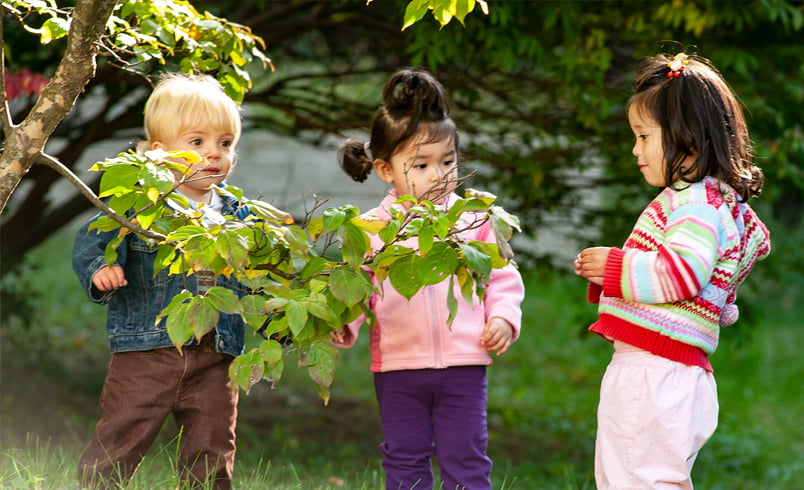
Why Nature-Based Learning Should Start in Infancy
At First Roots Wild Roots, we believe in the importance of nature-based learning for all ages, beginning with our youngest learners. Infants meet the natural world not as visitors, but as participants who are curious, capable, and ready to build relationships with the natural world through touch, movement, and wonder.
Let’s dig into the logistics of nature-based curriculum for those educators who are feeling overwhelmed or unsure about how to start.
Nature-Based Learning Is More Than “ Recess ”
Before we get into the nitty-gritty, it helps to understand what infants and toddlers are actually learning and why it is important.
Nature-based learning is often mistaken for “recess time.” In practice, it is a way of organizing curriculum around children's curiosity, relationships, and lived experiences. Children should have both unstructured and structured learning opportunities throughout the day. Teachers may find themselves getting stuck in the logistics of curriculum, such as “I need to plan a math activity for the morning and perhaps a science activity this afternoon.” Through nature-based curriculum, developmental domains and learning standards are met authentically.
In addition to planned learning invitations, teachers can also follow the child's lead, taking a seemingly small interaction and scaffolding it into a deep learning experience. Educators are frequently documenting their observations of the group to help guide their curriculum planning.
Here is one example of how small moments can turn into deep learning, and how every experience outdoors is a sensory experience.
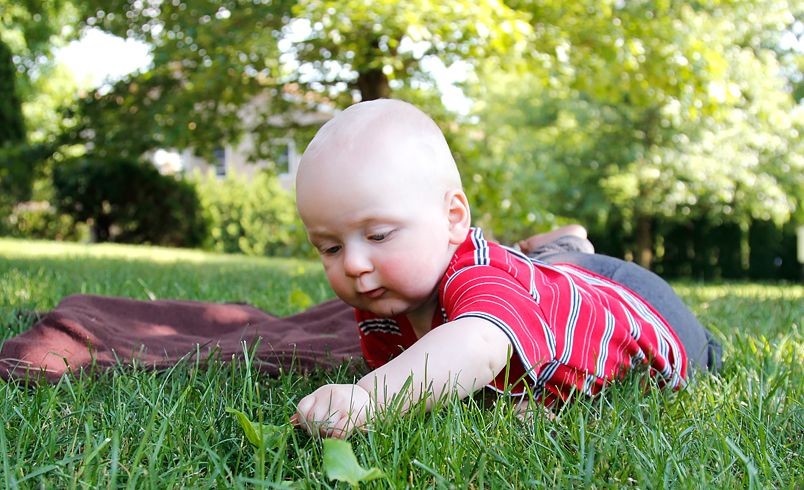
An infant gets strapped into the stroller, kicking their feet excitedly. They take a bumpy walk through the field and down the grassy hill, listening to their teacher singing a song as they walk to the edge of the forest, where their teacher lays out a picnic blanket. The infant lies on the blanket, gazing up into the canopy of branches. Light glimmers through the leaves as the wind blows gently through the branches. They hear the rustle of leaves, the call of a chickadee nearby, and the rhythmic tapping of a woodpecker in the distance. They feel the cool breeze on their skin and through their wisps of hair. They feel the soft blanket, roll over onto their stomach, and reach forward to touch the tickly grass. They pull at the grass and comb their fingers into the soil below. “How does the grass feel?” their teacher asks them. “I wonder if it feels wet and cool from the morning dew?” The infant finds a worm in the grass and is nervous about the wiggly, squirmy creature. “Oh, you found a worm enjoying the morning sun. It is so pink and squiggly. Would you like to feel the worm gently with your finger?” The teacher supports them in petting the worm gently, hand over hand. “How does the worm feel? I think the worm feels a little cold and it feels soft too. I wonder where it is going? Let’s wave goodbye to the worm and let them continue on their adventure.” The teacher finds a book in their wagon called “Worm Weather” and points out the pink, squiggly worms in the book, like the one they found.
In those ten or so minutes, the child was learning about their world. Within this single experience, learning happened across developmental domains. Here are a few examples:
- Social and emotional development: They displayed trust and connection to their teacher, regulated their emotions with their teacher and through sensory input, learned how to interact with another living being (the worm), learned impulse control to touch gently with the support of their teacher.
- Language and literacy development: The teacher narrated what was happening and asked open-ended questions to introduce deeper thinking and understanding. The teacher read a book, pointing out the similarities of the pictures and the story to their real-life experiences, which helped deepen the child’s understanding.
- Science: The infant showed interest in their environment, using their senses to explore. The teacher modeled language and exploration of the characteristics of the worm and the grass.
Is It Dangerous?
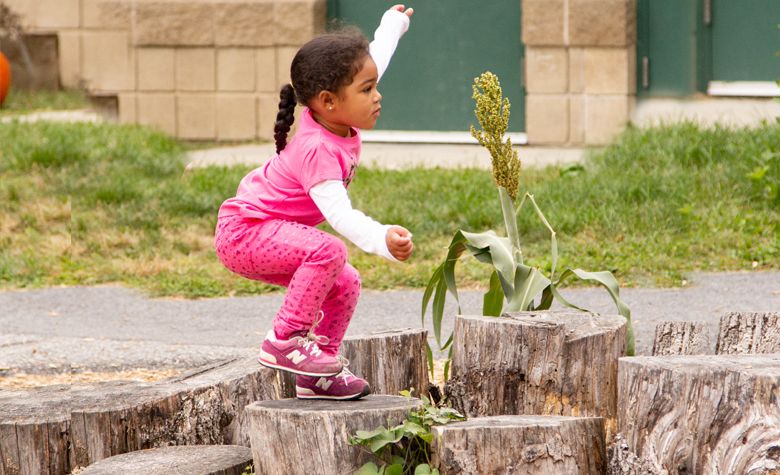
Everyone has different comfort levels with nature and risky play. We encourage educators to create a “yes space” by asking themselves, “What is the benefit, and how can I support this safely?” This might mean redirecting and a new location to help children meet their needs: “It looks like you really want to climb! The fence is not safe for climbing. Let’s find a new climbing spot! Maybe on those logs?”
Educators need to evaluate, “Is this risky or dangerous?” Risky might look like a child climbing up a large rocky hill in the woods. Dangerous would be if there was a steep riverbank on the other side. Adults should also be scanning and assessing the areas they enter with children to look for potential dangers (loose limbs, broken glass, or trash, etc.).
There is a risk of small injuries during outdoor exploration and play, such as if the child falls and gets a scraped elbow or knee. However, the benefit of the risk is that the toddler grows in confidence, tries something new, even if it is a little scary, and their bodies grow stronger as they learn about balance and coordination.
Avoid saying “be careful!” and instead offer detailed instructions or ask questions to help children develop their own risk assessment and problem-solving skills: “That log looks shiny and wet. Does it feel a little slippery? How can you move your body to get across safely? Would you like to try crawling across?”
One rule-of-thumb to follow with risky play is to never put a child where they couldn’t get themselves. For example, allow the child to climb up onto the top of a fallen tree instead of placing them atop it. This way, they are building the skills on their own to get back down safely as well.
Think Outside the Box and Outside the Playground
While visiting a local preschool classroom to share our passion for nature-based learning, the educators said, “Well this is wonderful, but we just can’t do that here.” Looking around, we saw a large, open field opposite the parking lot which led to a lush, green forest. The potential of the environment was overwhelming, yet the teachers couldn’t see outside their playground space. “What if a child needs to use the potty? What if we walk out there and then have to turn right back around for lunch?” With a little preparation and a little courage, anything is possible.
Preparation is not about control, but about providing freedom. With preparation and a little pre-teaching with children, teachers may feel more confident to explore and adventure.
At First Roots, we put an emphasis on preparation. Each classroom has the following:
- Walkie talkies for each teacher to alert others of their location. For example, “The Owl classroom has two teachers and eight children at the fairy circle at the park.”
- Neon safety vest for each teacher, so they can easily be spotted by children and adults in the community
- Rain bibs provided for each teacher, so they can join in on the muddy puddle splashing!
- Water jug for water bottle refills (and a thermos for warm tea in the winter)
- Emergency backpack for each teacher with first aid kit, alcohol free hand sanitizer, extra wipes, emergency contact information, attendance clipboards
- Portable changing mat
- A gear wagon (or gear sled in the winter!)
- An exploration box (magnifying glasses, child size binoculars, child tweezers, collection bags, child-safe scissors, gloves, notebooks, pencils)
- Waterproof picnic blanket (a camping tarp also works well and is easy to clean!)
Once toddlers become confident walkers, they can practice going on adventures and carrying a child-size backpack. Children can carry their water bottles, sunscreen and bug spray for reapplication, extra clothing, diapers, and small snacks for longer explorations. Lunch boxes (with ice packs inside) can also go into the backpacks or in a gear wagon to have meals outdoors.
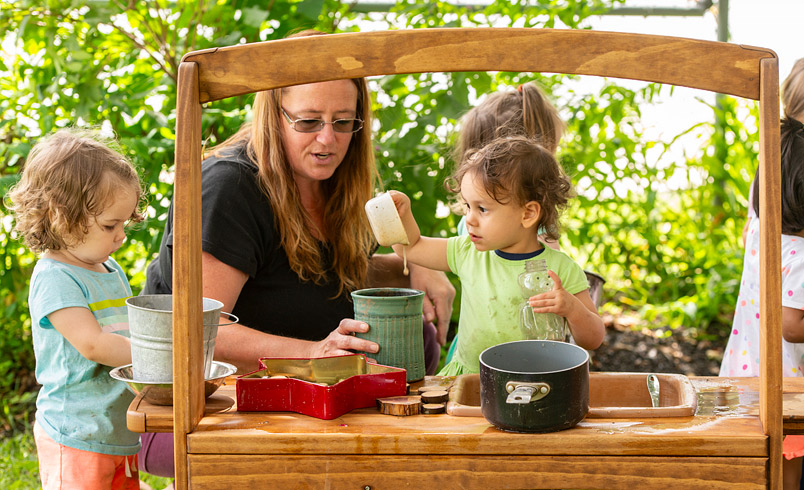
Don’t be afraid to allow “indoor materials” to become “everywhere materials.” Load up your gear wagon with art supplies, books, loose parts, baby dolls, toy animals, trucks, dramatic play materials, etc. Materials will get dirty, and a toy washing station is a fun activity for children to help get them clean again!
What If We Don’t Have Access to Natural Environments?
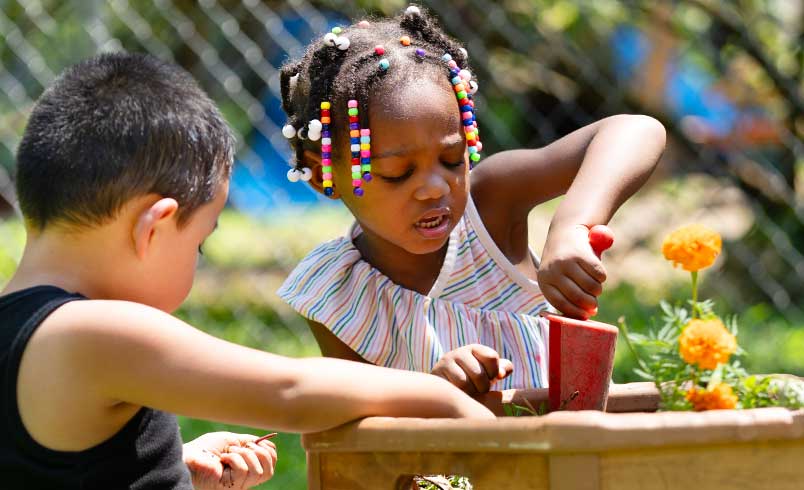
For many programs, access to forests, riverbanks, or open fields is limited by location. Nature-based learning, however, is not defined by acreage; it is defined by intention. There are many ways to bring nature into your playspaces and to make them feel magical and resourceful. One simple way is to add gardens! Flower, vegetable, and herb gardens can provide many learning opportunities, sensory experiences, and provide food for your children and families.
One example is mint! Mint can grow so quickly (and take over your garden, beware!). It provides sensory exploration: How does it smell? How does it feel? How does it taste? Our classrooms love to make “sun tea” in the summer, by picking fresh mint and chamomile from our gardens, putting them in a pitcher of water in the hot sun during the morning and enjoying the warm sun tea during lunch. Also, because it grows so abundantly, children can pick mint and use it for painting or in their mud kitchen recipes.
Use flower gardens to your advantage to create hiding spots and flower wonderlands. You can plant sunflower circles, pussy willow huts, or climbing pea pods along a fence to transform your space. Get down and visualize how the space looks from the child’s point of view. To them, a flower garden may be a colorful, fragrant, and mysterious jungle to explore!
Other natural materials you can add to your playspaces are logs, stumps, wood cookies, bark, stones, and sand.
How We Take Learning Outside at First Roots Wild Roots
What Does “Pre-Teaching” Look Like?
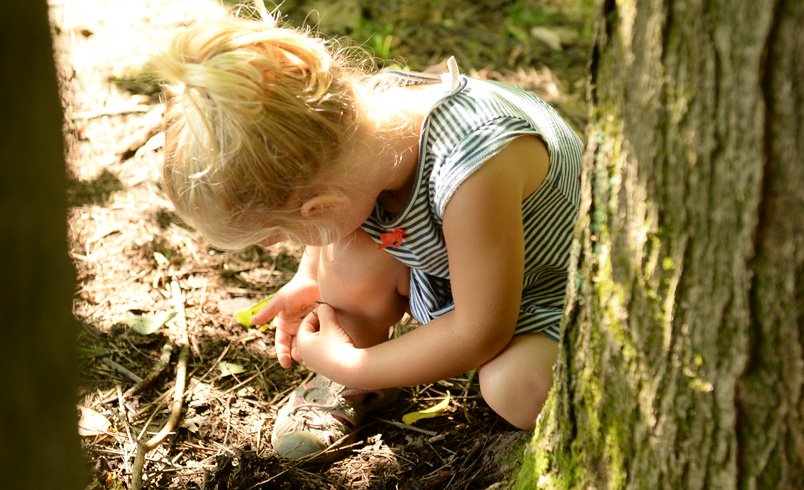
Our number one priority is always the safety of children. Before classrooms are ready to explore the forest, the riverbanks, the pond, the steep hiking trails of the park, or circle around a camp fire, teachers prepare and practice with children.
The first step with any new group of children is to build trust between peers and adults. This takes time, which means you may not be ready for a long hike in the woods with a new class of freshly turned two-year-olds during the first week of the school year. Build trust slowly and start small, such as taking a small group for a short walk, setting clear boundaries, and reflecting together after.
Giving clear and visual expectations for children is essential. “We are going to go for a walk to the big maple tree across the field. You can run if you would like until we reach the park bench, then we will stop and wait for everyone to catch up.” But what if they don’t stop at the bench? Set the boundary clearly and explain why it is important. You can still make things fun while setting clear expectations and giving opportunities for a “re-do.” Allow children to display their growth and learning and to be proud. “Remember that we are stopping at the bench to let everyone catch up. It’s really important on adventures to keep everyone safe. Will you help me keep everyone safe? We can be the safety team together! On the walk back, will you help me lead the way?” Know your class, where they are developmentally, and what support they may need. Every group is different—some may need more support and guidance than others.
Meeting Needs Outdoors
Meals? Diapers? Nature pees?! Again, preparation will make all the difference!
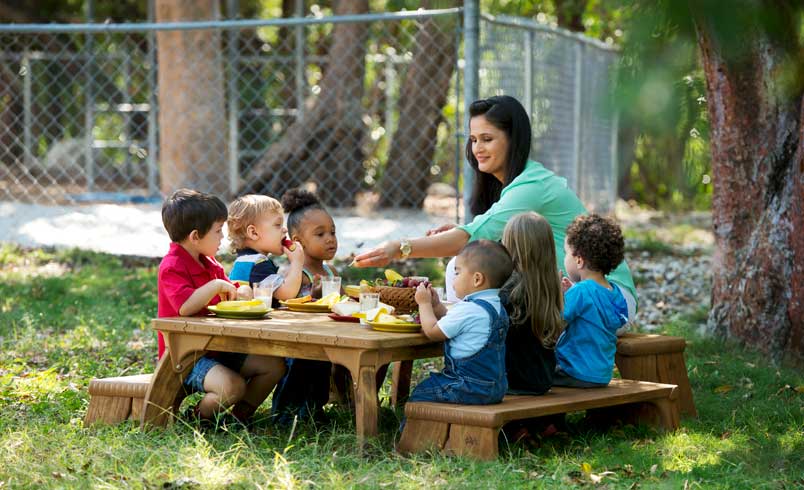
Meals: We ask families to pack two ice packs in their child’s lunch box to keep food fresh while out on adventures. Children can sit at a picnic table on the playground for meals or grab a large camping tarp to toss down for meals while out on adventures. Pack a plastic bin (with a lid) full of clean utensils and bibs, just in case. Bring along a “dirty dish bin” in your gear wagon.
Infant bottles can be warmed inside and brought along to enjoy outdoors, too! We have also been known to bring out our Community Playthings chairs with trays for the infants to have outdoor meals!
Bathrooming: Diapering and toileting outdoors requires the same respect, privacy, and calm presence as it does indoors. Our rule of thumb is that over 50°F is okay for bums to be out! Pack a portable changing mat, alcohol wipes (to clean it after each change), trash bags, gloves, and children's diapers and wipes (don’t forget to label!). Children’s diapering materials can be kept in their individual backpacks, in a teacher backpack or in a large plastic tote (refill during nap time for the afternoon). While out on adventures in the woods and with no bathroom nearby, children can practice a nature pee! Find a spot that is away from where children are playing and out of walking paths.
A Common Concern: Inclement Weather
There is an old saying that “there is no such thing as bad weather, only bad gear.” Here in Northern Vermont, we experience a variety of weather and seasons (sometimes all in the same day!).
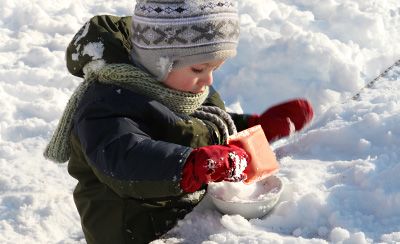
In the winter, we follow the “feels like” temp to help guide our time spent outdoors. For example, if the temperature is 20°F, we will go outside for 20 minutes before having a warm-up break. A warm-up break may be heading inside for a few minutes, having warm tea or oats from our thermos, or making a visit to the local library.
Pro tip: Boppies fit well into a large sled to help infants who need support with stabilization!
Children and educators will wear rain bibs or “muddy buddy” suits to stay dry during wet, rainy days, and we encourage puddle jumping as much as possible!
Here are our program’s safe temp guidelines:
- Over 50°F - meals, barefoot play (on playground only), and outdoor diaper changes/potty
- Between 40-60°F - puddle play with appropriate gear and adult attention to extremities
- Over 70°F - waterplay
In the summer, we ensure that shade is provided, and take frequent water breaks (singing “Happy Water Break to you” to the tune of “Happy Birthday” works well), and bring out the wading pools, sprinklers, water tables, and have the hose available for children with a push “kid faucet” spigot, which allows children to collect their own water with a slow drip flow.
Small Moments, Big Learning
Nature-based learning with infants and toddlers does not require elaborate materials or perfect outdoor spaces. Instead it just needs some thoughtful planning and a willingness to slow down and to be curious alongside children. When teachers model curiosity, respect, and excitement about the natural world, children will naturally follow. Together we can nurture a sense of wonder and responsibility for the earth. Caring for the environment can be playful as well, such as knocking on a log (“knock, knock, are any wormies home?”) before overturning it to search for the insects and creatures below, or a simple “Good morning, mama maple tree. May we play around you today?”
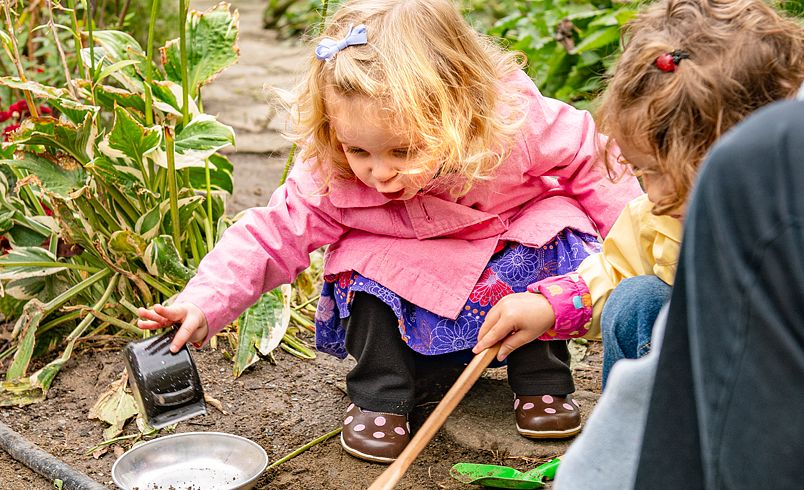
Remember that the small moments, such as the toddler balancing on top of a log and the infant crunching a dried leaf, are not separate from curriculum, they are curriculum. When we trust infants and toddlers as capable learners and treat the natural world as another “classroom,” those small learning moments become meaningful experiences.