Responsive Scaffolding - Windows of Opportunity to Stretch Play Outdoors
| October 2026Editor's Note
This article is part of a series of articles exploring how the Four Intentions of the Complementary Curriculum Approach—Compelling Materials, Explicit Presentation, Responsive Scaffolding, and Following Children’s Interests—can be applied in the outdoor classroom. In this article, we'll focus on three strategies for Responsive Scaffolding.
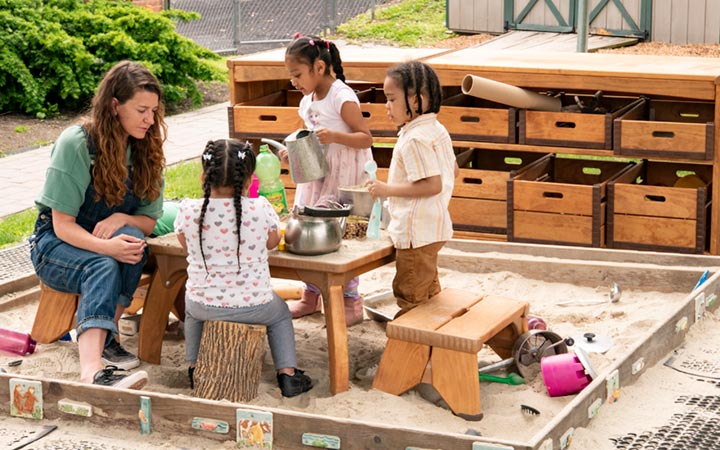
Once children head outdoors, it can be tempting for adults to take a bit of a break. While the outdoor environment lends itself to free play, children benefit from supervision for safety as well as observation that gives teachers information about how to support play. During outside time teachers should be spread across the different zones, observing and entering play as needed. The third intention of the Complementary Curriculum Approach is Responsive Scaffolding and it focuses on the windows of opportunity to enter children’s experiences and support new learning both indoors and out. Scaffolding, a term most often attributed to psychologist and theorist Lev Vygotsky, refers to the support a child receives as they move from what they can do independently to new levels of competence. You know how a puzzle suddenly becomes so easy that a child loses interest, but present them with one that offers a little more challenge and they are now deeply engaged! Learning grows via development but also through repeated experience and interactions with adults and peers (Kuh & Ponte, 2022).
Being an early educator is grounded in the joy of observing children as they discover new possibilities and supporting them in the leaps of understanding and awareness. Responsive Scaffolding asks educators to observe children’s play and interactions with materials in order to learn what they are trying to understand and what kinds of challenges they are looking for next. It refers specifically to the ways teachers move in and out of children’s play, offering coaching and strategies for children to use as they develop skills and knowledge. This coaching, or scaffolding, grows from and strengthens trusting relationships between children and teachers.
It is important to note that many teachers consider scaffolding a technique for children when they are in an indoor classroom. This article will consider the critical nature of Responsive Scaffolding in outdoor settings.
Strategy #1: Gradual Release
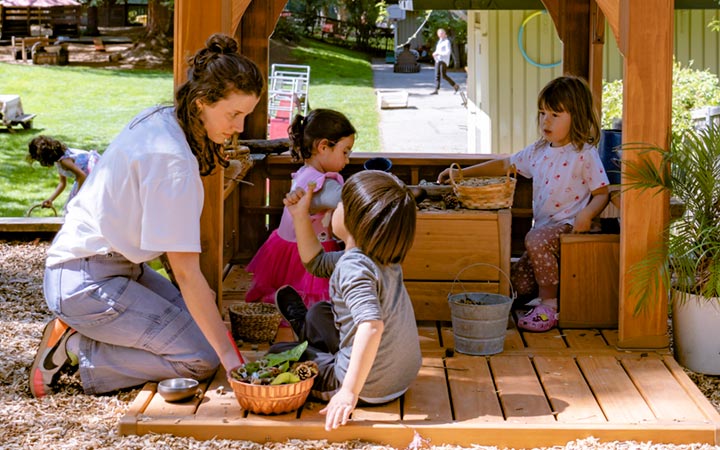
A group of children are playing in the sand pit. Using dry sand the children fill containers and try to dump them out to make “cakes”. The teacher takes the hose and dribbles water into the sand. “Hmm, I wonder what will happen if I add water to this sand—oh look the sand sticks together now!”
Gradual Release is a critical part of scaffolding. Gradual Release involves creating a distance between the teacher and the child, so that the child can fully experience the activity independently. A good example is teaching children to make their own sand structures. Model how to care for and use tools. Narrate as you use your hands and water so that with practice the child can create something independently. “Hmm, I wonder what will happen if I add water to this sand - oh look the sand sticks together now!” Supporting children to independently pump on a swing is another opportunity for scaffolding. We could spend the day offering never ending swing pushes, but eventually we want children to learn to pump themselves and experience the thrill of going higher and higher under their own power. Gradually push only every other swing and offer some technical support. “You pointed your toes and pushed yourself higher!” You might even swing side by side with a child and talk about what you are doing with your arms and legs. Then step away saying, “I am going to help some other friends in the playground but you keep trying and I will be back.” Supporting children with careful steps and practice to independence offers them the chance to feel the joy of a new experience.
Strategy #2: Engage in the Activity Yourself
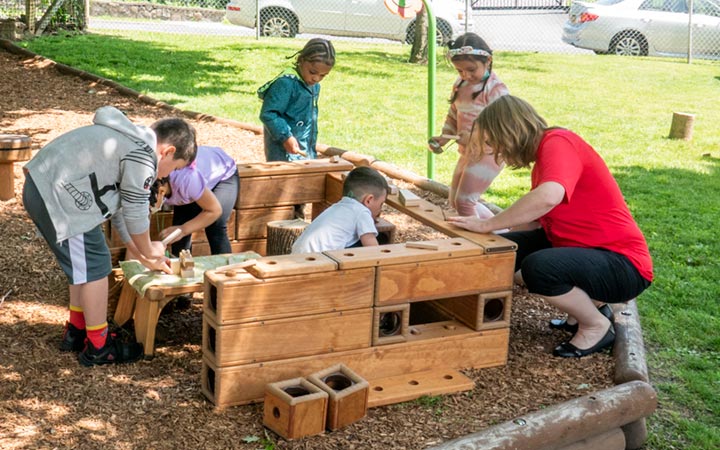
When educators model joy as they interact with materials or try different experiences, children will follow. The goal is not to have children mimic exactly what we do but rather see new ways of working with materials that may have challenges they have not considered. This can look like teachers working in the mud kitchen to use different materials to mix and transfer, or in an open grass area kicking a ball into a goal. If educators make experiences look engaging and interesting, children are more likely to join in. Narration proves helpful here as well. You might approach the mud kitchen saying, “I think I want to play here today. What will I make? Maybe Jonas will play with me. Let’s mix mud soup!” You can also just swing on the swings, hunker down in the sand area and quietly build. Chances are the children are watching.
Strategy #3: Invite the Children to Coach Each Other
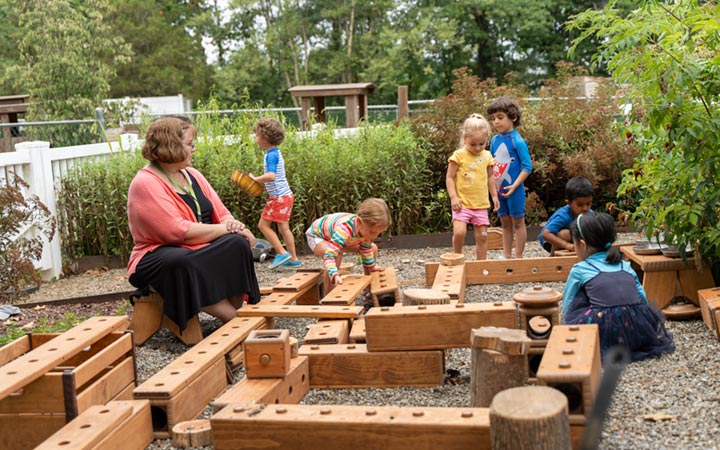
Just as children can learn from teachers, they can also learn from each other. Children have a range of abilities in a variety of areas that teachers can tap into. Children are highly capable of helping each other, pairing up to work together on a task where one child can learn from another. The opportunity for children to learn from each other gives children a chance to be leaders and models, as well as co-constructors and co-collaborators. This can take many forms in outdoor spaces. A child with expertise with a bug box can model for a student that has never used one. An opportunity for an older student to support a younger student to build with outlast blocks. Even trying a balance beam or slide experience can be mentored from one child to another. You can facilitate this when a child asks for help saying, “You know who is an expert builder? Janelle. Let’s go ask her to show us how she makes her buildings so tall and strong.” Or for a child who wants to try something new, “Jeremy, can you please show Risa how to use the bug box? I know you have used it before.” Then the teacher steps away and observes, only re-entering the play if really needed.
Closing
If you are wondering when Responsive Scaffolding should happen, the answer is “Always!” It can happen throughout the day and in any area of the classroom or playground. Responsive Scaffolding is not about what you are doing “for” or “to” children; it is about being an ally, a co-collaborator, a helper, and a facilitator. All this is in the service of helping children feel proud, confident, and competent as they develop new skills, insight, and new levels of learning.
Learn more at www.complementarycurriculum.com and sign up for the online course.
References
Berk, L. E., & Winsler, A. (1995). Scaffolding children’s learning: Vygotsky and early childhood education. National Association for the Education of Young Children.
Kuh, L. P., & Ponte, I. C. (2022). Complementary curriculum approach: Transform your practice through intentional teaching. Exchange Press
Vygotsky, L. S. (1978). Mind in society: The development of higher psychological processes (M. Cole, V. John-Steiner, S. Scribner, & E. Souberman, Eds.). Harvard University Press.