Destination Zones: Building Opportunities for Outdoor Discovery Using the Complementary Curriculum
| September 2026
Have you ever wondered if you are maximizing your outdoor space? Does it feel like your outdoor play space is an afterthought, and you want to find a way to make it more organized and successful for your teachers and children?
In our book, the Complementary Curriculum Approach, we highlight the critical nature of prepared environments. Classroom environments, both inside and out, influence how children feel, how they interact with one another and materials, and how they behave. Destination zones that invite children into engaged play are an essential component of classroom design. Zones beckon children into spaces for a range of play experiences and give children a place to land, to focus, to explore, to practice new movements and new materials. These zones are not siloed but rather build connections across areas for more complex, cooperative, and constructive play. In many ways, the search for the settled classroom originates in the spaces that teachers design and offer to children. The settled classroom is a space where children are free to choose materials and experiences that interest and delight them, have the time and space to concentrate on meaningful, interesting activities, and work and play joyfully as part of a community of learners.
Spending some time thinking about your physical environment prepares you to engage with the Four Intentions (Compelling Materials, Explicit Presentations, Responsive Scaffolding, and Following Children’s Interests) that are at the heart of the Complementary Curriculum Approach. In the outdoor classroom, those intentions begin not only with what materials are available, but also with how the spaces and materials work together, and help children connect their play experiences across the playscape.
What the Research Tells Us
Children’s exploration of space is an important part of discovery and development. (Hart 1987; Kyttä 2006). When you design with destination zones in mind, each area affords children the opportunity to engage with spaces in new ways and learn different things (Fjørtoft 2004; Gibson 1986; Spencer and Blades 2006). Exploratory behaviors are crucial for the development of gross-motor skills, a sense of initiative, and self-regulation (Pellegrini 2005; Smilansky 1968). The ability to explore and discover in a natural environment offers possibilities for children to be critical thinkers and co-constructors of their play experiences, with adults as respectful guides who take children’s endeavors seriously (Dahlberg, Moss and Pence 1999; Gandini 1998; Heft and Chawla 2006; Moss and Petrie 2002).
Destination zones are a place for children to land, focus, and explore—to practice new movements and new materials. Zones should build connections across the learning environment to allow for more complex, cooperative, and constructive play.
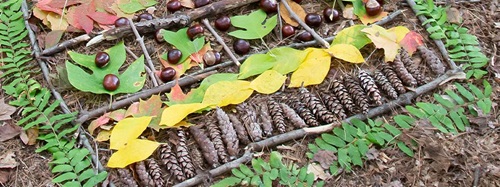
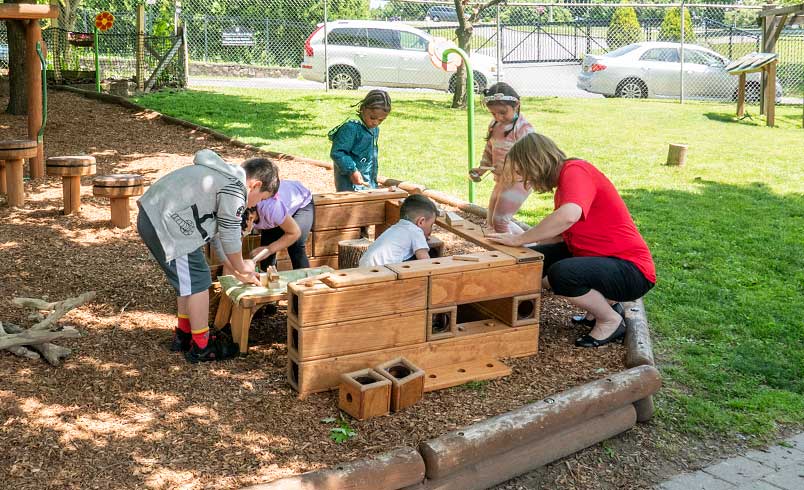
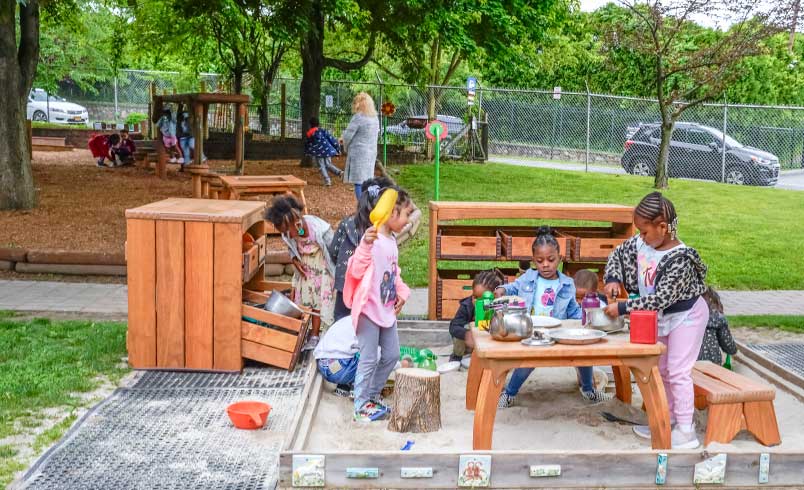
Outdoor environments are naturally rich in surfaces, spaces, and objects that encourage children to engage in a wide range of motor activities, such as climbing, running, balancing, jumping, and manipulating objects. Logs and large blocks such as the Outlast Blocks in a playground that require multiple children to move promote cooperative play; pinecones and fallen branches engage children in a focused, self-initiated investigation in a playhouse or mud kitchen. Sandboxes are another venue for loose parts and construction. An art shed becomes a place for creating items that provision the playhouse. The Four Intentions can guide teachers as they design these connections. Compelling materials invite investigation; explicit presentations make materials accessible and understandable; responsive scaffolding allows teachers to adapt the environment to children’s emerging play; and following children’s interests helps teachers notice what the environment is already telling them.
The Prepared Environment: Consider Your Space and Create Your Zones
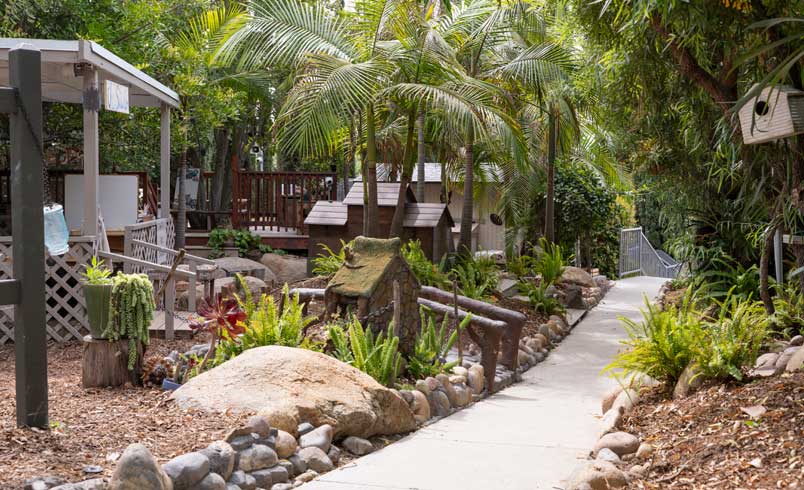
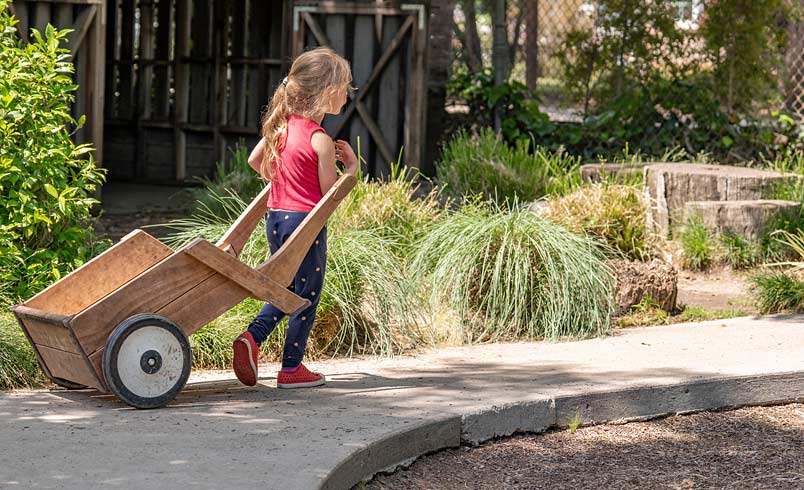
As a child enters an outdoor play space, they benefit from an environment that invites them into the various zones and provides opportunities for different kinds of play. The design of these spaces encourages children to move their bodies in different ways, to linger in places, and influences their behaviors such as engaging in focused observation of insects or big body play on a hillside. There are many things to consider when developing play areas or zones. Look at the natural affordances of the space: what is there already that you can take advantage of? An open flat grassy area supports running and group games. An area clustered in trees or in a corner might be the perfect spot for a quiet zone where children huddle together with small manipulatives or books and voices are softer. A spot near a water source would be well-situated for the mud kitchen/dramatic play zone. Pathways can be used for biking, walking, and running, as well as pulling wagons. Paths connect the different areas and afford children the opportunity to carry things from one place to another depending on their play ideas. They also provide a predictable way to move through the environment, helping children to understand how the different areas of the outdoor space connect. These visual and physical cues help children anticipate transitions and recognize that a change in space may signal a change in the kinds of experiences available to them. Predictable pathways and transitions can be especially supportive for children with neurodiverse or sensory processing needs, for whom knowing what to expect can contribute to a greater sense of safety and comfort.
While outdoor play is fluid as children move through various zones, consider design that meets children’s various needs. For example, there are advantages to putting a quiet zone near an art area where play might be less rambunctious. A mud kitchen or dramatic play zone near a climber can expand story plots that children develop. While children will move across zones during play, natural boundaries can help provide some loose structure that offers children a sense of safety and identification of a particular area. Landscape borders, ground coverings, small walls, different surfacing all mark entry and exit of a zone. An archway often provokes children to slow down and control their movements. Pathways made of woodchips require different movements than a pathway made of soft surfacing or pavement. A little bridge connecting two areas signals a new experience and might require different body movements. These transitions give children additional clues about how the environment changes from one area to another, while still allowing them to move freely between zones. The goal is not to control children’s movement, but to provide cues that help them understand where they are, where they might go, and what kinds of experiences might be possible there.
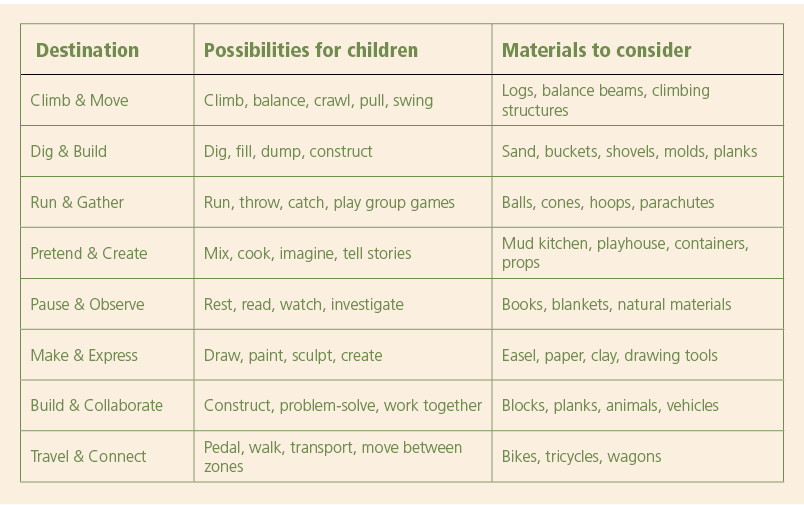
Here are a few descriptions to get you started on designing and preparing your outdoor environment. As with the indoor classroom, outdoor materials should be selected and stored intentionally. Children should be able to access and return materials independently when possible. Materials can be rotated according to children’s needs and interests, and “less is more” can help prevent a space from becoming overwhelming. Keeping materials clean and in good repair also supports productive play and encourages children to care for their environment.
Destination zones to consider:
As your program considers how to improve your playground space, keep in mind that the changes you choose to make do not need to be monumental. Small steps can lead to big changes for both teachers and children. Engaging the children in these changes is key. Take children in whole or small groups on a playground tour to introduce the zones and care of materials and spaces there. Talk about the plants and surfaces. Maybe start by organizing your outdoor materials differently. Regardless of where you begin, remember to give yourself permission to be your best self as an educator. Find time to reflect on practice and document how children are using the space. And don’t forget to celebrate all of the successes and joy you find on your school playground.
References
Dahlberg, Gunilla, Peter Moss, and Alan Pence. 1999. Beyond Quality in Early Childhood Education and Care: Postmodern Perspectives. London: Falmer Press.
Fjortoft, Ingunn. 2004. “Landscape as Playscape: The Effects of Natural Environments on Children’s Play and Motor Development.” Children, Youth, and Environments 14 (2): 21–44.
Gandini, Leila. 1998. “Educational and Caring Spaces.” In The Hundred Languages of Children, 2nd ed., edited by Carolyn Edwards, Lella Gandini, and George Forman. Westport, NH: Ablex Publishing.
Gibson, James. 1979/1986. The Ecological Approach to Perception. Hillsdale, NH: Lawrence Erlbaum Associates.
Hart, Roger. 1987. “Children’s Participation in Planning and Design: Theory, Research, and Practice.” In Spaces for Children: The Built Environment and Child Development, edited by Carol Simon Weinstein and Thomas G. David. New York: Plenum Press.
Heft, Harry, and Louise Chawla. 2006. “Children as Agents in Sustainable Development: The Ecology of Competence.” In Children and Their Environments: Learning, Using, and Designing Spaces, edited by Christopher Spencer and Mark Blades. Cambridge, UK: Cambridge University Press.
Kyttä, Marketta. 2006. “Environmental Child-Friendliness in the Light of the Bullerby Model.” In Children and Their Environments: Learning, Using, and Designing Spaces, edited by Christopher Spencer and Mark Blades. Cambridge, UK: Cambridge
Moss, Peter, and Pat P. Petrie. 2002. From Children’s Services to Children’s Spaces. New York: Routledge/Farmer.
Pellegrini, Anthony. 2005. Recess: Its Role in Education and Development. Mahwah, NJ: Lawrence Erlbaum Associates.
Smilansky, Sara. 1968. The Effects of Sociodramatic Play on Disadvantaged Preschool Children. New York: John Wiley & Sons, Inc.