Floorbooking: Solving the Documentation Problem Your Teachers May Not Realize They Have
| September 2026Editor’s Note: Raven Casey is an early childhood educator who teaches at First Roots – Wild Roots, a nature-based preschool in Vermont where children spend most of their day learning outdoors using an emergent curriculum. In this article, she shares her experience using Floorbooks®—large, collaborative documentation books developed by outdoor educator Claire Warden—as an alternative to traditional classroom documentation. Floorbooks® bring together children's words, drawings, photographs, collected natural materials, and teacher observations, making children's thinking and learning visible while helping educators plan responsive curriculum.
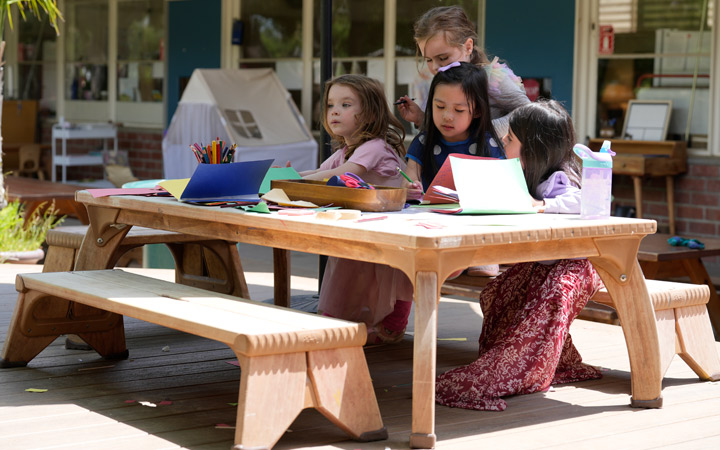
It’s an average Tuesday at First Roots – Wild Roots in Vermont. My co-teacher and I lead our group of fifteen preschoolers into the woods, where we set up a hammock, a pile of books, and open-ended nature activities. On a nearby log bench, I place a large sketchbook and invite a small group to join me. Today’s prompt builds on something these children naturally love: collecting and observing. I ask them to find a flower they think is beautiful. If they find many of the same flower growing nearby, they can bring one back to tape into the sketchbook.
Rewind to one year previously, during my annual review, my supervisors noticed that traditional methods of documenting learning in the classroom were not working for my own learning style; I could not rationalize placing pictures, narratives, quotes and learning standards on a wall when we were adventuring outside for most of the day. With my administrators' support and suggestion, I attended a webinar that detailed an alternative, called the Floorbook Approach®, created by UK-based outdoor educator Claire Warden. This approach resonated deeply with my own teaching style and philosophy, so I set out to try it with my group of preschoolers. Since then, many classrooms throughout our nature-based emergent curriculum program—from infants through age eight—have adopted Floorbooks® as their primary documentation tool.
Benefits for Children
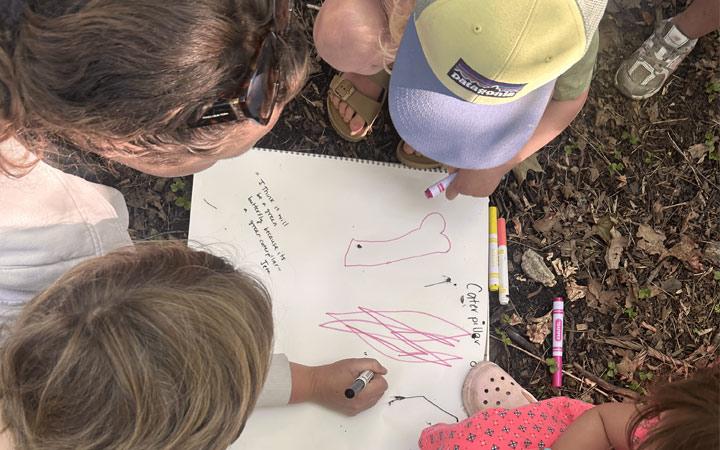
After the children tape in their flowers to the Floorbook®, we discuss what we notice about the children’s findings. I use open-ended questions to guide them, such as, “What do you notice about these plants?” and “What do you wonder about?” in addition to asking if they can identify the flowers they picked. If they cannot, we discover together at a later time using our field guides and plant identification apps. While I’m asking individual children these questions, others are drawing their own version of what they saw or experimenting with writing letters or letter-like forms. I supervise their drawings while transcribing others’ responses verbatim into the Floorbook®. Most preschoolers will also practice writing their names under their finding or drawing.
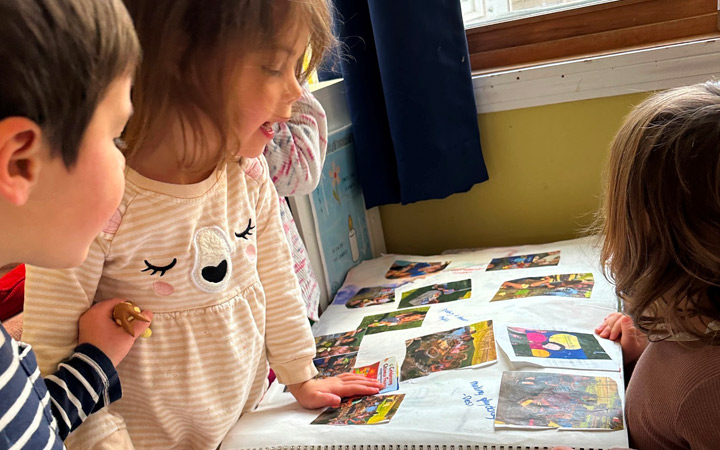
The children in my care love flipping through past Floorbook® entries to see how they are represented as individuals in our classroom community. Oftentimes, they compliment each other’s art or narrate what they remembered from a photo, naturally engaging in conversation about each other’s perspectives. In these moments, where they are crowded around the big, blank pages of the floorbook, their social-emotional development and executive functioning are at play. Waiting their turn to tell their stories is important, and seeing their exact words written on a page next to their peers’ is often the easiest reason to wait. When they’re asking each other about their drawings, they are developing social-emotional and language skills. These learning domains are not separate; they are embedded in this process giving children a sense of ownership over their learning.
Sometimes I facilitate these discussions about each other's work while we are adding to the floorbook; other times, we wait to reflect on the next day or after their afternoon nap.
In many classrooms, children practice early writing by tracing letters or words that are meaningful to them. Sometimes children gravitate toward that kind of learning; however, I found that floorbooking made those same literacy experiences feel more organic and play-based. Rather than asking children to complete a separate writing activity after an investigation, documenting their discoveries became the writing activity itself. With my knowledge of pre-literacy skills, it was easy to meet each individual child's developmental needs while we worked together on the Floorbook®. For example, when we were talking about plant identification, some three-year-olds might scrawl vertical zigzags to show they had labeled a “red clover,” while an older child might ask me to write the letters on a sticky note to copy directly onto the page. For someone like me who values social exchange in learning, facilitating these moments of differentiation felt natural because documenting our learning was already part of the classroom routine.
Benefits for Teachers
One of the greatest strengths of Floorbooks® is that documentation becomes a collaborative process. As children and teachers work together to record learning throughout the day, documentation is woven into classroom life instead of becoming another task waiting during planning time. This shift changed the way I planned curriculum, assessed children's development, and reflected on their growth. Watching that growth unfold in real time—and documenting it alongside the children—changed the way I thought about assessment.
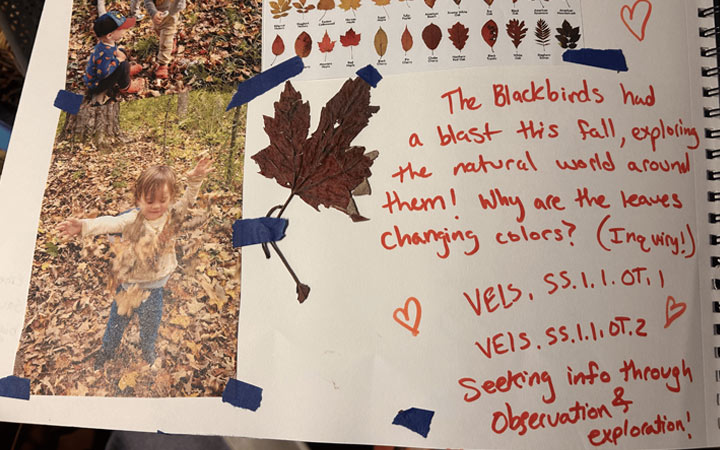
Although the bulk of floorbooking happens in collaboration with children, some tasks still happen independently, such as adding learning standards and reviewing entries during planning time. Looking back through previous pages helps teachers identify children's interests, notice developmental progress, and plan experiences that build naturally on their emerging ideas.
Floorbooks® also provide a rich record of children's development over time. Consecutive entries reveal growth in language, literacy, drawing, and communication, making it easy to see how children’s thinking changes from one month to the next. Before family conferences, I often read through each child’s contributions from beginning to end. Together, those pages told a much richer story of growth than isolated observations ever could.
Additionally, because of their portable nature, Floorbooks® are excellent resources to take to conferences, workshops, and other gatherings where teachers from different programs connect. Colleagues can flip through them, discuss documentation practices, and gather inspiration for their own classrooms. Unlike traditional documentation panels, floorbooks travel wherever the learning happens.
Benefits for Families
Unlike documentation panels that are fixed to the wall, floorbooks move with the classroom, making it easier for families to flip through it at drop-off or pick-up in a place-based or nature-based setting where children are not inside during those moments. Looking through Floorbooks® as a parent can give a different perspective of the children’s learning; it may show the connections between the activities and child development, which families are not always aware of. Families can also read the entries and use them as talking points to bridge or support the home-school connection and further support their children’s metacognitive skills at home.
Benefits for Program Leaders and Licensing
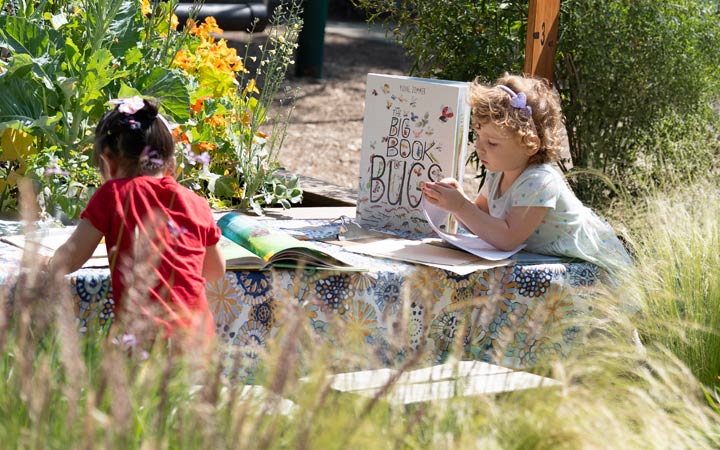
By linking learning objectives directly to activity photos, quotes, children’s drawings, and artifacts collected by the children, teachers can clearly demonstrate the precise learning that occurred during play in an accessible way for directors and licensors. This way of making learning visible helps connect children’s authentic play directly to learning objective rather than relying on teacher summaries alone.
For example, a page about collecting flowers may appear to document a simple nature walk. Looking more closely, however, reveals mathematics as children classify and count flowers, science as they identify plants and discuss why they grow in particular places, and social studies as they build relationships with their local environment. Because these experiences are documented alongside relevant learning objectives, floorbooks provide clear, accessible evidence of the rich learning that emerges through play.
Conclusion
After using both traditional documentation panels and floorbooks, I now prefer Floorbooks® because they make documentation part of the learning process instead of a separate task. They create community, simplify assessment, strengthen family communication, and preserve children's thinking in their own words. More than a record of learning, a Floorbook® becomes the shared story of a classroom.
Learn more about Floorbooks® at Dr. Claire Warden’s MindStretcher Academy website.