The Power of Explicit Presentation in the Complementary Curriculum Approach
A Study in Outlast Blocks
| June 2026Editor's Note
This article is part of a series of articles exploring how the Four Intentions of the Complementary Curriculum Approach—Compelling Materials, Explicit Presentation, Responsive Scaffolding, and Following Children’s Interests—can be applied in the outdoor classroom. Each article will highlight one intention and examine how it supports children’s learning, engagement, and success with outdoor materials and experiences.
In this installment, we focus on Explicit Presentation and its role in helping children safely and confidently engage with Outlast Blocks. Explicit Presentation introduces children to the properties, possibilities, and care of materials, creating a foundation for independent exploration, creativity, and discovery.
Explicit Presentation and Outlast Blocks
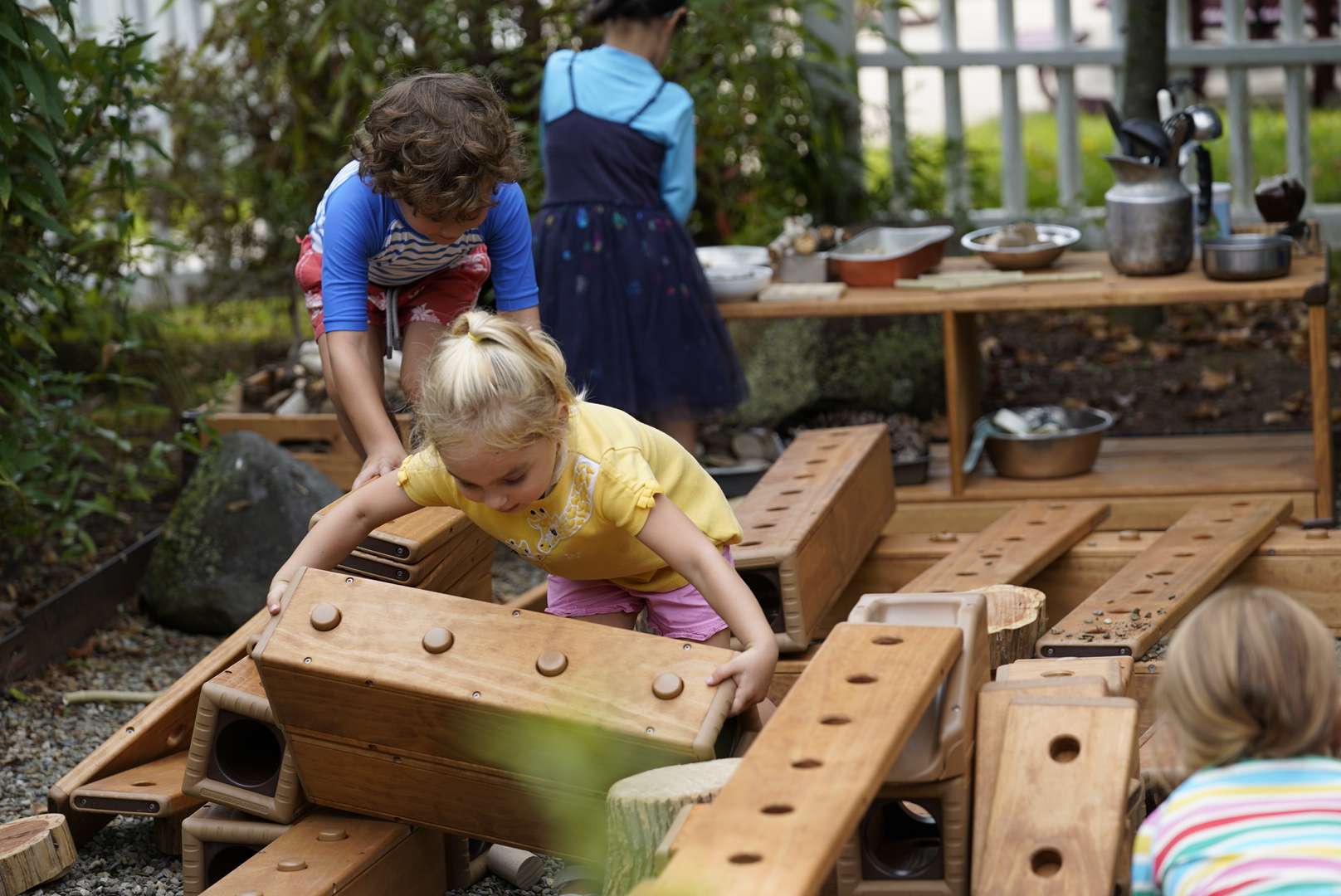
We were thrilled when our Outlast Shed and full set of Outlast Blocks arrived. We thought carefully about placement—next to a fence with an open expanse of grass. The wooden storage shed soon became an exciting new play zone. But having the right materials in the right spot was only part of the work. We still had to think about how to orient children to something so new and interesting, and that required intention.
It can be tempting when you have a new material, to just put it out with little to no explanation of how to use and care for these materials. While in some cases this is fine, children often benefit from modeling that supports their explorations. Children thrive when they have freedom within a structure, and the structures don’t mean that everything is teacher directed or controlled. Instead, Explicit Presentation of materials introduces the children to the properties of a material and then turns over the play and discovery. Through thoughtful modeling, children gain the confidence to engage creatively with their environment and to care for it. While we might think about this as something we only apply to indoor spaces, boosting creativity and safety outside means approaching experiences with intention. Knowing how to present materials to children requires some technique, and the Complementary Curriculum Approach offers important entry points to children’s success with materials in the outdoor environment.
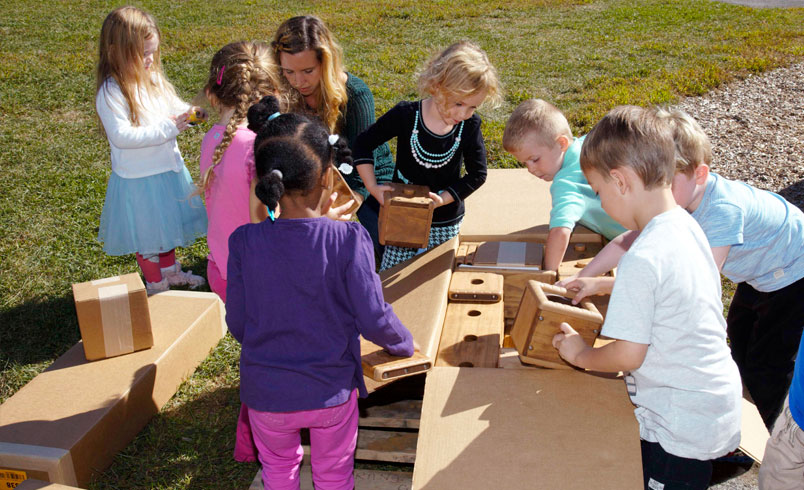
Explicit Presentation refers to the practice of modeling everyday routines, activities, and the use of classroom materials, through descriptive language and non-verbal cues. The children had no experience using such large and heavy blocks. We needed to think carefully about how we would invite them to safely use, enjoy, and be successful with this new building material. After a few meetings with the school leadership and teachers, we came up with an Outlast Blocks Explicit Presentation lesson plan that would make these new materials both safe and successful for children’s independent use and align our practices across classrooms.
Through explicit presentations we gave the children the information they needed to independently and successfully interact with the new blocks. This way, creativity and curiosity can grow from foundational knowledge. Our goal was to give children the knowledge needed to take up their own explorations, discoveries, and challenges. As you read through our lesson plan, think about how you can adapt this presentation to other areas in your outdoor play space, as you introduce children to other destination zones such as swings, slides, playhouses, and sand areas.
Outlast Blocks Explicit Presentation
Invite the Children
Invite a group of children, ideally a small group, to see the new materials. Gather them in front of the area or materials you wish to present. Be sure to leave ample space so the Outlast Shed can be opened easily and allow for enough building space in front of it.
We sing a gathering song to alert the children that a new material is being presented. “Come on over and make a circle, make a circle, make a circle.”
Name the Material or Area and Share Ground Rules
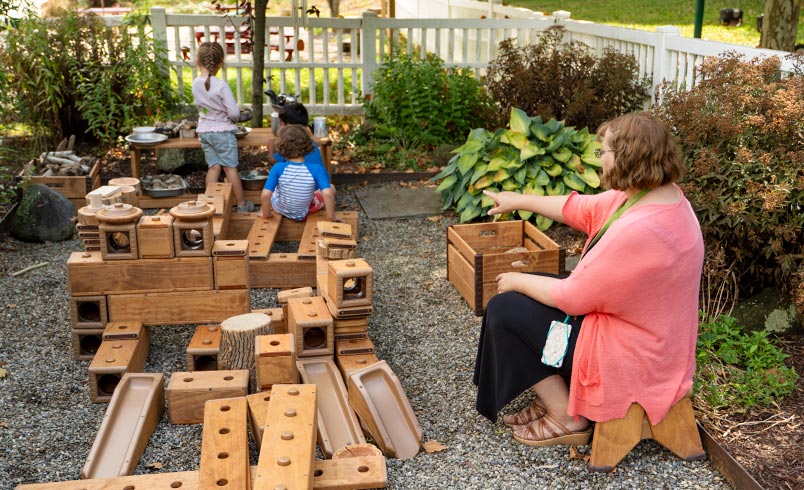
“This is called our community block shed. This is where the blocks live.”
Each setting will need to make a decision about how children access the blocks. What is important is to clearly share the ground rules up front so children understand the boundaries and can be successful in their play.
Think carefully about the ages of your children and what access might look like when first introducing the blocks and later when children are more comfortable handling them. Children can get overwhelmed by lots of new materials and early on, less is more, as children get used to the weight and size of the blocks, building physical skills and healthy risk taking as they carry and manipulate them. Initially, make sure there are a variety of sizes so children can experience the range of materials but consider limiting the number of blocks in circulation.
As children become more comfortable with the blocks, they begin to access them independently and develop cooperation skills by passing blocks to one another and taking on roles such as “block passer” and “block carrier.”
Model Handling and Use of the Material or Area
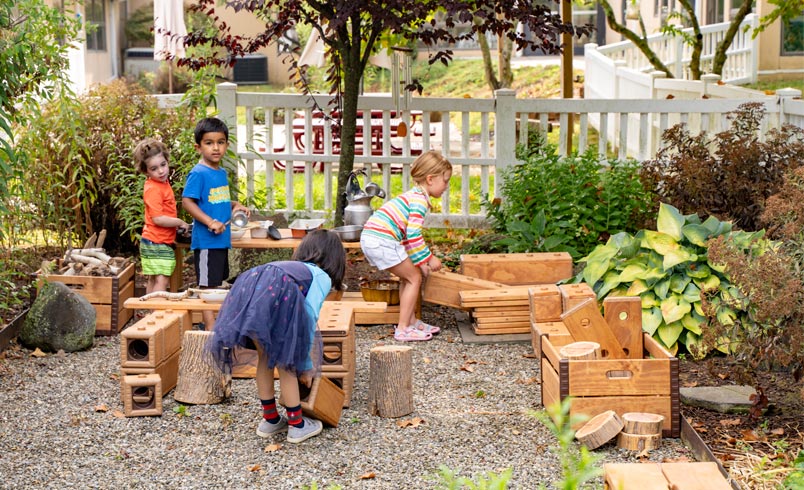
“Watch my body as I carefully take blocks out of the shed. Today I am only going to take out some of the blocks since we are just learning to use them.” (Without speaking, take some out and place them on the ground, looking at them with curiosity.) “Let’s take a close look at these blocks. What do you notice? Yes, that’s right! The blocks have bumps on this side and holes on the other. Let me show you how they can connect!”
For the initial introduction to the Outlast Blocks, remove just some of the blocks so children can get used to handling them and get a sense of their weight and properties. Pause and with minimal language model removing blocks, demonstrating how to carry them, hand placement, and gently placing them on the ground one at a time in an organized way, perhaps lining them up or clustering them in a group. Then close the shed so children do not have access. Notice that when we model, we use minimal language so children can focus on our movements.
Model some of the strategies children will need to know such as carrying, stacking, and unstacking the blocks.
“I want to show you a few ways you can use these blocks. Watch carefully. This is called stacking.”
Quietly begin to stack a few blocks on top of each other. You can also model making an enclosure or any strategy you think children might need to know at this point. Observe the children’s play to see how they are using the blocks and how you might scaffold their play as they become more familiar with the material.
Advanced Building Strategies
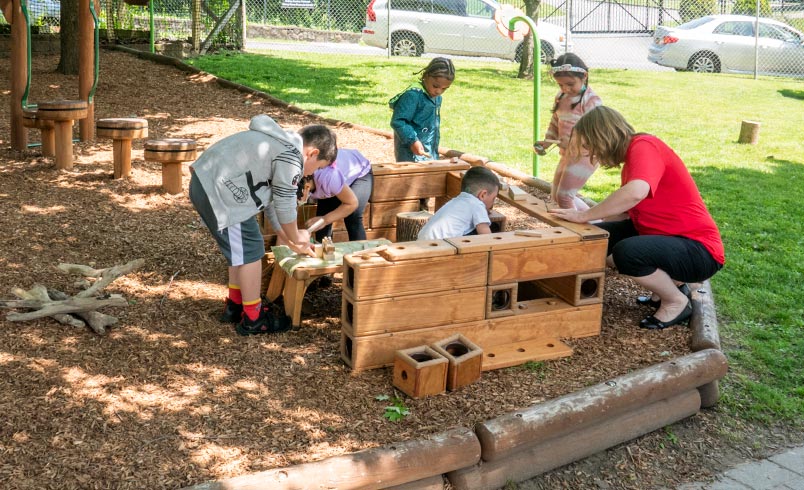
At some point you will want to model more sophisticated and complex strategies, although children may discover these on their own with success. Children naturally stack and enclose, and eventually want to build bridges, things they can get into and walk on or across, and taller structures. Note: Discuss ahead of time with school leadership and teachers any safety guidelines that should be shared with children.
“We noticed you have been trying out using these planks. Today I want to show you how to make a structure that is stable. I want to make something I can walk on. This plank is really heavy and long. How can I move it? You are right, I need a friend to help.”
Invite a co-teacher or another child to model how to safely carry and move the long plank around the open grass area. Be sure to move slowly to show careful movements. Invite the children to problem-solve.
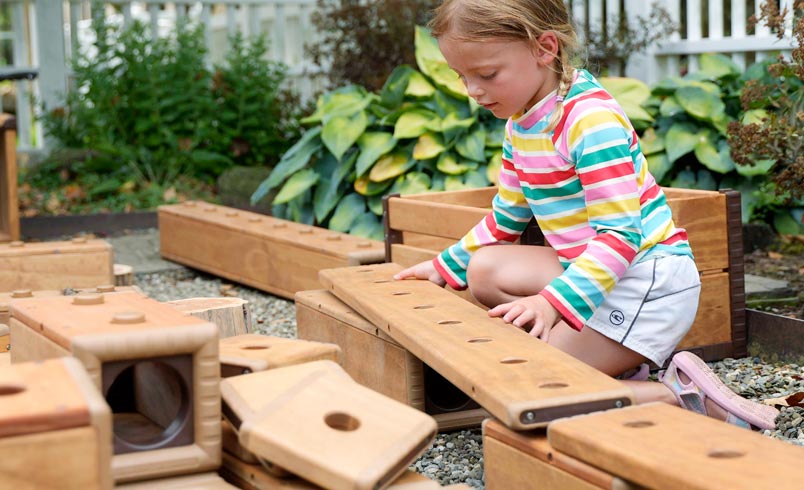
“Now that I have the plank here, I need to look to see what block will be sturdy enough to prop up one side. Which one should I use? Yes! This one will work.”
Demonstrate how to connect the plank to the blocks in a stable way.
“I would like to show you how to build something tall. When we build tall things, we need a secure base.”
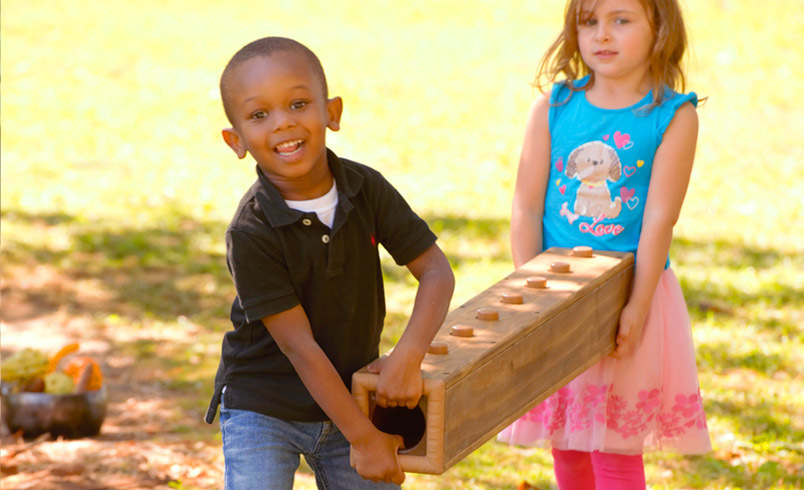
Model safe and slow carrying of blocks and how to connect them to build upwards. Introduce any safety guidelines pertaining to building taller structures. Also demonstrate how to partner to carry blocks that are too heavy for one child.
Demonstrate How to Reset and Return Materials
“Remember that these are called community blocks. This means that we share and work together to make things and that we put them away carefully to get them ready for the next day.”
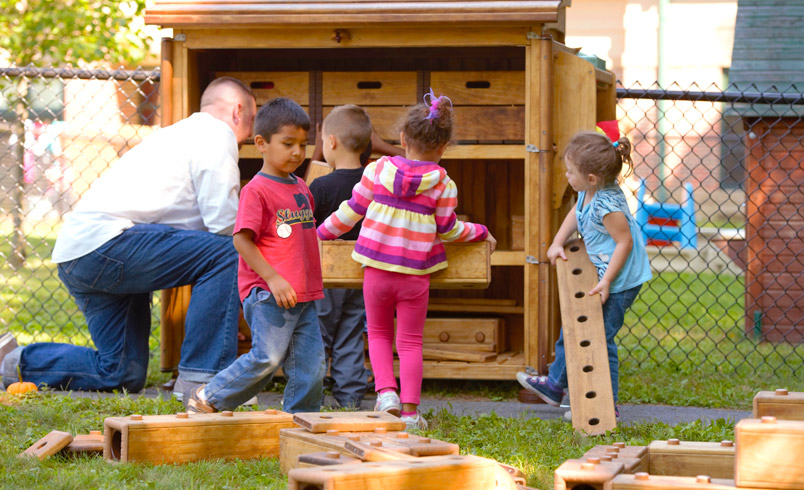
You will need to decide what this looks like. Children might be responsible for carrying blocks and lining them up on the side of the shed or designated area while an adult puts them back. This way the children can experience taking down and resetting the material and practice working as a community to care for their outdoor space.
Outcome and Experience
One of the keys to Explicit Presentation is determining when to step back. You want to provide just enough modeling so that you inspire exploration rather than creating an adult-led experience. Presentations should not be long, drawn-out or heavily verbal. Instead, the modeling invites the children into the materials and teachers do a warm handoff of the materials as soon as they can. This transition is key to children’s feelings of agency and confidence with the materials you offer. We often ask, after a short presentation, “Are you ready to try on your own?” or simply say, “Now your turn!” Once you turn the materials over to the children, ensure that they have some long stretches of time to really engage and get to know the new materials. Observing the play helps you to know when you might step back in to support and continue small modeling moments, perhaps offering to help carry a big block, problem solve a stability or construction dilemma, or support a social issue. When educators scaffold play responsively by moving in and moving out, it reinforces engagement, focus, and discovery.
Using the intentions of the Complementary Curriculum Approach helps ensure that children experience success, are more creative, require less teacher support, and that materials are cared for, indoors and out.